Wednesday, August 07, 2024

Victor Hugo


Victor Marie Hugo - Feb. 26, 1802-May 22, 1885


Victor Hugo is considered the most important of the French Romantic writers. Poet, novelist, dramatist -- The Hunchback of Notre Dame and Les Misérables are among his best known works.

In 1827 he wrote that romanticism is the liberalism of literature.

His lyrical style has been described as 'rich, intense and full of powerful sounds and rhythms.

Hugo's funeral in 1885 was a national event, attended by two million people.


Some works by Victor Hugo:


A Sunset (From "Feuilles d'Automne")

I love the evenings, passionless and fair, I love the evens,
Whether old manor-fronts their ray with golden fulgence leavens,
In numerous leafage bosomed close;
Whether the mist in reefs of fire extend its reaches sheer,
Or a hundred sunbeams splinter in an azure atmosphere
On cloudy archipelagos.

Oh, gaze ye on the firmament! a hundred clouds in motion,
Up-piled in the immense sublime beneath the winds' commotion,
Their unimagined shapes accord:
Under their waves at intervals flame a pale levin through,
As if some giant of the air amid the vapors drew
A sudden elemental sword.

The sun at bay with splendid thrusts still keeps the sullen fold;
And momently at distance sets, as a cupola of gold,
The thatched roof of a cot a-glance;
Or on the blurred horizon joins his battle with the haze;
Or pools the blooming fields about with inter-isolate blaze,
Great moveless meres of radiance.

Then mark you how there hangs athwart the firmament's swept track,
Yonder a mighty crocodile with vast irradiant back,
A triple row of pointed teeth?
Under its burnished belly slips a ray of eventide,
The flickerings of a hundred glowing clouds in tenebrous side
With scales of golden mail ensheathe.

Then mounts a palace, then the air vibrates--the vision flees.
Confounded to its base, the fearful cloudy edifice
Ruins immense in mounded wrack;
Afar the fragments strew the sky, and each envermeiled cone
Hangeth, peak downward, overhead, like mountains overthrown
When the earthquake heaves its hugy back.

These vapors, with their leaden, golden, iron, bronzèd glows,
Where the hurricane, the waterspout, thunder, and hell repose,
Muttering hoarse dreams of destined harms,--
'Tis God who hangs their multitude amid the skiey deep,
As a warrior that suspendeth from the roof-tree of his keep
His dreadful and resounding arms!

All vanishes! The Sun, from topmost heaven precipitated,
Like a globe of iron which is tossed back fiery red
Into the furnace stirred to fume,
Shocking the cloudy surges, plashed from its impetuous ire,
Even to the zenith spattereth in a flecking scud of fire
The vaporous and inflamèd spaume.

O contemplate the heavens! Whenas the vein-drawn day dies pale,
In every season, every place, gaze through their every veil?
With love that has not speech for need!
Beneath their solemn beauty is a mystery infinite:
If winter hue them like a pall, or if the summer night
Fantasy them starre brede.

Translated by Francis Thompson (1859-1907).


More Strong Than Time

Since I have set my lips to your full cup, my sweet,
Since I my pallid face between your hands have laid,
Since I have known your soul, and all the bloom of it,
And all the perfume rare, now buried in the shade;

Since it was given to me to hear on happy while,
The words wherein your heart spoke all its mysteries,
Since I have seen you weep, and since I have seen you smile,
Your lips upon my lips, and your eyes upon my eyes;

Since I have known above my forehead glance and gleam,
A ray, a single ray, of your star, veiled always,
Since I have felt the fall, upon my lifetime's stream,
Of one rose petal plucked from the roses of your days;

I now am bold to say to the swift changing hours,
Pass, pass upon your way, for I grow never old,
Fleet to the dark abysm with all your fading flowers,
One rose that none may pluck, within my heart I hold.

Your flying wings may smite, but they can never spill
The cup fulfilled of love, from which my lips are wet;
My heart has far more fire than you can frost to chill,
My soul more love than you can make my soul forget.

Translated by Andrew Lang (1844-1912).


The Genesis of Butterflies

The dawn is smiling on the dew that covers
The tearful roses; lo, the little lovers
That kiss the buds, and all the flutterings
In jasmine bloom, and privet, of white wings,
That go and come, and fly, and peep and hide,
With muffled music, murmured far and wide.
Ah, the Spring time, when we think of all the lays
That dreamy lovers send to dreamy mays,
Of the fond hearts within a billet bound,
Of all the soft silk paper that pens wound,
The messages of love that mortals write
Filled with intoxication of delight,
Written in April and before the May time
Shredded and flown, playthings for the wind's playtime,
We dream that all white butterflies above,
Who seek through clouds or waters souls to love,
And leave their lady mistress in despair,
To flit to flowers, as kinder and more fair,
Are but torn love-letters, that through the skies
Flutter, and float, and change to butterflies.

Translated by Andrew Lang (1844-1912).


The Poor Children

Take heed of this small child of earth;
He is great; he hath in him God most high.
Children before their fleshly birth
Are lights alive in the blue sky.

In our light bitter world of wrong
They come; God gives us them awhile.
His speech is in their stammering tongue,
And his forgiveness in their smile.

Their sweet light rests upon our eyes.
Alas! their right to joy is plain.
If they are hungry Paradise
Weeps, and, if cold, Heaven thrills with pain.

The want that saps their sinless flower
Speaks judgment on sin's ministers.
Man holds an angel in his power.
Ah! deep in Heaven what thunder stirs,

When God seeks out these tender things
Whom in the shadow where we sleep
He sends us clothed about with wings,
And finds them ragged babes that weep!

Translated by Algernon Charles Swinburne (1837-1909).


-- Cat

Thursday, June 27, 2024

Heinrich Heine


Painting by Moritz Daniel Oppenheim

Christian Johann Heinrich Heine (born Chaim Harry Heine)
December 13, 1797 – February 17, 1856

Heinrich Heine, of Jewish origin, was one of the most significant of the German poets. His lyrics inspired such composers as Mendelssohn, Schubert, and Schumann, and his poem 'Die Lorelei', set to music in 1837, has become a lastingly popular German song.

One of his most famous quotes, though it originally referred to the Spanish Inquisition, proved prophetic regarding events more than 100 years after his death:

Where they have burned books, they will end in burning human beings.
(Dort, wo man Bücher verbrennt, verbrennt man am Ende auch Menschen)

Heinrich Heine, From his play Almansor (1821)


Some works by Heinrich Heine


Death and his Brother Sleep (‘Morphine’)

There’s a mirror likeness between those two
shining, youthfully-fledged figures, though
one seems paler than the other and more austere,
I might even say more perfect, more distinguished,
than he, who would take me confidingly in his arms –
how soft then and loving his smile, how blessed his glance!
Then, it might well have been that his wreath
of white poppies gently touched my forehead, at times,
and drove the pain from my mind with its strange scent.
But that is transient. I can only, now, be well,
when the other one, so serious and pale,
the older brother, lowers his dark torch. –
Sleep is so good, Death is better, yet
surely never to have been born is best.


A Palm-tree

A single fir-tree, lonely,
on a northern mountain height,
sleeps in a white blanket,
draped in snow and ice.

His dreams are of a palm-tree,
who, far in eastern lands,
weeps, all alone and silent,
among the burning sands.


The Old Dream Comes Again to Me

The old dream comes again to me:
With May-night stars above,
We two sat under the linden-tree
And swore eternal love.

Again and again we plighted troth,
We chattered, and laughed, and kissed;
To make me well remember my oath
You gave me a bite on the wrist.

O darling with the eyes serene,
And with the teeth so white!
The vows were proper to the scene,
Superfluous was the bite.


Prologue

Good-Fortune is a giddy maid,
Fickle and restless as a fawn;
She smoothes your hair; and then the jade
Kisses you quickly, and is gone.

But Madam Sorrow scorns all this,
She shows no eagerness for flitting;
But, with a long and fervent kiss,
Sits by your bed—and brings her knitting.


The Voyage

As at times a moonbeam pierces
Through the thickest cloudy rack,
So to me, through days so dreary,
One bright image struggles back.

Seated all on deck, we floated
Down the Rhine's majestic stream;
On its borders, summer-laden,
Slept the peaceful evening-gleam.

Brooding, at the feet I laid me
Of a fair and gentle one,
On whose placid, pallid features
Played the ruddy-golden sun.

Lutes were ringing, youths were singing,
Swelled my heart with feeling strange;
Bluer grew the heaven above us,
Wider grew the spirit's range.

Fairy-like beside us flitted
Rock and ruin, wood and plain ;
And I gazed on all reflected
In my loved one's eyes again.


Where?

Where shall I, of wandering weary,
Find my resting-place at last?
Under drooping southern palm-trees?
Under limes the Rhine sweeps past?

Will it be in deserts lonely,
Dug by unfamiliar hands?
Shall I slumber where the ocean
Crawls along the yellow sands?

It matters not! Around me ever
There as here God's heaven lies,
And by night, as death-lamps o'er me,
Lo, His stars sweep through the skies!


The Lorelei (Die Lorelei - translated by A Z Foreman)

I know not if there is a reason
Why I am so sad at heart.
A legend of bygone ages
Haunts me and will not depart.

The air is cool under nightfall.
The calm Rhine courses its way.
The peak of the mountain is sparkling
With evening's final ray.

The fairest of maidens is sitting
Unwittingly wondrous up there,
Her golden jewels are shining,
She's combing her golden hair.

The comb she holds is golden,
She sings a song as well
Whose melody binds an enthralling
And overpowering spell.

In his little boat, the boatman
Is seized with a savage woe,
He'd rather look up at the mountain
Than down at the rocks below.

I think that the waves will devour
The boatman and boat as one;
And this by her song's sheer power
Fair Lorelei has done.

Original:

Ich weiß nicht, was soll es bedeuten,

Daß ich so traurig bin;
Ein Märchen aus alten Zeiten,
Das kommt mir nicht aus dem Sinn.

Die Luft ist kühl, und es dunkelt,
Und ruhig fließt der Rhein;
Der Gipfel des Berges funkelt
In Abendsonnenschein.

Die schönste Jungfrau sitzet
Dort oben wunderbar,
Ihr goldenes Geschmeide blitzet,
Sie kämmt ihr goldenes Haar.

Sie kämmt es mit goldenem Kamme
Und singt ein Lied dabei;
Das hat eine wundersame,
Gewaltige Melodei.

Den Schiffer im kleinen Schiffe
Ergreift es mit wildem Weh;
Er schaut nicht die Felsenriffe,
Er schaut nur hinauf in die Höh'.

Ich glaube, die Wellen verschlingen
Am Ende Schiffer und Kahn;
Und das hat mit ihrem Singen
Die Lorelei getan.

--Cat

Tuesday, March 12, 2024

Mary Hunter Austin


Mary Hunter Austin (September 9, 1868 – August 13, 1934)

Illinois-born poet, novelist, playwright, at age twenty she moved with her family to California. Many of her works are based on her studies of Indian life in the Mojave Desert, about the land and the people she came to love. Her best known work is The Land of Little Rain, a tribute to the deserts of the Southwest.

She was known also for feminist essays and as a staunch defender of Native American and Spanish-American rights. She died in Santa Fe, New Mexico.


Some poetry by Mary Hunter Austin:


A Song In Time Of Depression

Now all my singing Dreams are gone,
But none knows where they have fled
Nor by what trails they have left me.

Return, O Dreams of my heart,
And sing in the Summer twilight,
By the creek and the almond thicket
And the field that is bordered with lupins!

Now is my refuge to seek
In the hollow of friendly shoulders,
Since the singing is stopped in my pulse
And the earth and the sky refuse me;
Now must I hold by the eyes of a friend
When the high white stars are unfriendly.

Over-sweet is the refuge for trusting;
Return and sing, O my Dreams,
In the dewy and palpitant pastures,
Till the love of living awakes
And the strength of the hills to uphold me.

From the Paiute.


Going West

Someday I shall go West,
Having won all time to love it in, at last,
Too still to boast.

But when I smell the sage,
When the long, marching landscape line
Melts into wreathing mountains,
And the dust cones dance,
Something in me that is of them will stir.

Happy if I come home
When the musk scented, moon-white gilia blows,
When all the hills are blue, remembering
The sea from which they rose.
Happy again,
When blunt faced bees carouse
In the red flagons of the incense shrub,
Or apricots have lacquered boughs,
And trails are dim with rain!

Lay me where some contented oak can prove
How much of me is nurture for a tree;
Sage thoughts of mine
Be acorn clusters for the deer to browse.
My loving whimsies -- Will you chide again
When they come up as lantern flowers?

I shall be small and happy as the grass,
Proud if my tip
Stays the white, webby moons the spider weaves,
Where once you trod
Or down my bleaching stalks shall slip
The light, imprisoning dew.
I shall be bluets in the April sod!

Or if the wheel should turn too fast,
Run up and rest
As a sequoia for a thousand years!


Inyo

Far from the northward, from the cloven ridges,
Pine-girt, deep-drifted with bewildering snows,
By ice-plowed gorge, the leaping river bridges,
Light span by span, from lake to lake below,
By mountain meadow, and the snow-fed hollow
Where birch and buckthorn thicket mark the trail,
Spurning the tawny hills in haste to follow
The long, brown reaches of a desert vale.

To east and west roll up the purple ranges,
Foot bound about by leopard-colored hills;
From east to west their serrate shadow changes;
From west to east stream down the tumbling rills.
Mocking the shadeless slopes and sullen ledges,
Through the sunburnt wastes of sage and yellow sand,
Run down to meet thy willows and thy sedges, --
O lonely river in a lonely land!

Foamless and swift thy winding waters follow
To find, unbosomed to the wind-swept skies,
The great lake lapping in a tideless hollow,
Wanton to each day's changes as they rise, --
Purpling to meet the splendor of their mornings,
Paling to catch their tender mid-day blue,
Trembling alike to smilings and to scornings, --
Fleet light of loves, it cannot hold one true.

Like some great lioness beside the river,
With passion slumbering in her half-shut eyes,
Watching the light from heated sands up-quiver,
Untamed and barren, lone the valley lies.
Forego, O River, all the wrong you do her,
Hasting your waters to the bitter lake,
Rise from your reedy marges and subdue her,
So shall the land be fertile for your sake.


Medicine Song: To Be Sung In Time Of Evil Fortune

Medicine me,
O Friend-of-the-Soul-of-Man,
With purging waters!
For my soul festers
And an odor of corruption
Betrays me to disaster.

As a place of carrion
Where buzzards are gathered,
So is my path
Overshadowed by evil adventures;
Meanness, betrayal, and spite
Flock under heaven
To make me aware
Of sickness and death within me.

Medicine my soul, O friend,
With waters of cleansing;
Then shall my way shine,
And my nights no longer
Be full of the dreadful sound
Of the wings of unsuccesses.


The Heart's Friend

Fair is the white star of twilight,
and the sky clearer
At the day's end;
But she is fairer, and she is dearer.
She, my heart's friend!

Far stars and fair in the skies bending,
Low stars of hearth fires and wood smoke ascending,
The meadow-lark's nested,
The night hawk is winging;
Home through the star-shine the hunter comes singing.

Fair is the white star of twilight,
And the moon roving
To the sky's end;
But she is fairer, better worth loving,
She, my heart's friend.

Shoshone Love Song.


Winter In The Sierras

The pines are black on Sierra's slope,
And white are the drifted snows;
The flowers are gone, the buckthorn bare,
And chilly the north wind blows.
The pine-boughs creak,
And the pine-trees speak
A language the north wind knows.

There's never a track leads in or out
Of the cave of the big brown bear;
The squirrels have hid in their deepest holes,
And fastened the doors with care.
The red fox prowls,
And the lean wolf howls
As he hunts far down from the lair.

The eagle hangs on the wing all day,
On the chance of a single kill;
The little gray hawk hunts far and wide
Before he can get his fill.
The snow-wreaths sift,
And the blown snows drift
To the canyons deep and still.


--Cat

Wednesday, February 21, 2024

Robinson Jeffers


Photograph by Carl Van Vechten, July 9, 1937


John Robinson Jeffers, the top of my list of favorite poets, was born January 10, 1887 in Pittsburgh, Pennsylvania and died Jan 20, 1962 in Carmel, California.

I was browsing his poetry, as I often do, and came across some works that, though written more than 60 years ago, seem to speak of the times. All times, it seems.

Jeffers was immensely popular, an unwilling "darling" of the literati of the twenties and thirties. But his intense antiwar sentiments, his criticism of America's entering WWII tossed him from favor. Although he later published several books of poetry, he never regained his initial acclaim.

These poems were published in 1963, one year after his death:

Birth And Death

I am old and in the ordinary course of nature
shall die soon, but the human race is not old
But rather childish, it is an infant and acts
like one,
And now it has captured the keys of the kingdoms
of unearthly violence. Will it use them? It
loves destruction you know.
And the earth is too small to feed us, we must
have room.
It seems expedient that not as of old one man,
but many nations and races die for the people.
Have you noticed meanwhile the population
explosion
Of man on earth, the torrents of new-born babies,
the bursting schools? Astonishing. It saps
man's dignity.
We used to be individuals, not populations.
Perhaps we are now preparing for the great
slaughter. No reason to be alarmed; stone-dead
is dead;
Breeding like rabbits we hasten to meet the day.


Shine, Perishing Republic

While this America settles in the mould of its vulgarity, heavily thickening
to empire
And protest, only a bubble in the molten mass, pops and sighs out, and the
mass hardens,
I sadly smiling remember that the flower fades to make fruit, the fruit rots
to make earth.
Out of the mother; and through the spring exultances, ripeness and deca-
dence; and home to the mother.

You making haste haste on decay: not blameworthy; life is good, be it stub-
bornly long or suddenly
A mortal splendor: meteors are not needed less than mountains:
shine, perishing republic.
But for my children, I would have them keep their distance from the thick-
ening center; corruption
Never has been compulsory, when the cities lie at the monster's feet there
are left the mountains.
And boys, be in nothing so moderate as in love of man, a clever servant,
insufferable master.
There is the trap that catches noblest spirits, that caught--they say--
God, when he walked on earth.


--Robinson Jeffers


~Perhaps, like Jeffers must have felt, today I'm simply depressed about the state of things in the world, this grand old beautiful world which seems yet again on a collision course with a man-made apocalypse.


Cat

Friday, February 02, 2024

Elinor Wylie


Elinor (Hoyt) Wylie September 7, 1885 – December 16, 1928

New Jersey-born Elinor Wylie led a passionate, flamboyant, sadly too short life. Her search for love led her into three marriages, all ultimately unsatisfactory. One biographer observed that she had three lives:

...That of childhood, shy, timorous, and fairly sheltered; followed by the second, which was passed buried alive; and the third, the shortest of all, as a very famous writer and woman. This period spanned eight years and she acted as if she knew it would be short.
----Olson, Stanley. Elinor Wylie: A Life Apart

She is currently noted as a minor poet which in my opinion does her an injustice. Her poetry, while often seen as depressing by those who "know" is lovely and speaks to me.

Some poems by Elinor Wylie:


Pretty Words

Poets make pets of pretty, docile words:
I love smooth words, like gold-enamelled fish
Which circle slowly with a silken swish,
And tender ones, like downy-feathered birds:
Words shy and dappled, deep-eyed deer in herds,
Come to my hand, and playful if I wish,
Or purring softly at a silver dish,
Blue Persian kittens fed on cream and curds.

I love bright words, words up and singing early;
Words that are luminous in the dark, and sing;
Warm lazy words, white cattle under trees;
I love words opalescent, cool, and pearly,
Like midsummer moths, and honied words like bees,
Gilded and sticky, with a little sting.


Sunset on the Spire

All that I dream
By day or night
Lives in that stream
Of lovely light.
Here is the earth,
And there is the spire;
This is my hearth,
And that is my fire.
From the sun's dome
I am shouted proof
That this is my home,
And that is my roof.
Here is my food,
And here is my drink,
And I am wooed
From the moon's brink.
And the days go over,
And the nights end;
Here is my lover,
Here is my friend.
All that I
Can ever ask
Wears that sky
Like a thin gold mask.


Song

It is my thoughts that colour
My soul which slips between;
Thoughts lunar and solar
And gold and sea-green

Tint the pure translucence
Of the crystal thread;
A rainbow nuisance
It runs through my head.

When I am dead, or sleeping
Without any pain,
My soul will stop creeping
Through my jeweled brain

With no brightness to dye it
None will see where
It flows clear and quiet
As a river of air;

Watering dark places
Without sparkle or sound;
Kissing dumb faces
And the dusty ground.


Winter Sleep

When against earth a wooden heel
Clicks as loud as stone on steel,
When stone turns flour instead of flakes,
And frost bakes clay as fire bakes,
When the hard-bitten fields at last
Crack like iron flawed in the cast,
When the world is wicked and cross and old,
I long to be quit of the cruel cold.

Little birds like bubbles of glass
Fly to other Americas,
Birds as bright as sparkles of wine
Fly in the nite to the Argentine,
Birds of azure and flame-birds go
To the tropical Gulf of Mexico:
They chase the sun, they follow the heat,
It is sweet in their bones, O sweet, sweet, sweet!
It's not with them that I'd love to be,
But under the roots of the balsam tree.

Just as the spiniest chestnut-burr
Is lined within with the finest fur,
So the stoney-walled, snow-roofed house
Of every squirrel and mole and mouse
Is lined with thistledown, sea-gull's feather,
Velvet mullein-leaf, heaped together
With balsam and juniper, dry and curled,
Sweeter than anything else in the world.

O what a warm and darksome nest
Where the wildest things are hidden to rest!
It's there that I'd love to lie and sleep,
Soft, soft, soft, and deep, deep, deep!


Sea Lullaby

The old moon is tarnished
With smoke of the flood,
The dead leaves are varnished
With colour like blood.

A treacherous smiler
With teeth white as milk,
A savage beguiler
In sheathings of silk

The sea creeps to pillage,
She leaps on her prey;
A child of the village
Was murdered today.

She came up to meet him
In a smooth golden cloak,
She choked him and beat him
to death, for a joke.

Her bright locks were tangled,
She shouted for joy
With one hand she strangled
A strong little boy.

Now in silence she lingers
Beside him all night
To wash her long fingers
In silvery light.


Death and the Maiden

BARCAROLE ON THE STYX

Fair youth with the rose at your lips,
A riddle is hid in your eyes;
Discard conversational quips,
Give over elaborate disguise.

The rose's funeral breath
Confirms by intuitive fears;
To prove your devotion, Sir Death,
Avaunt for a dozen of years.

But do not forget to array
Your terror in juvenile charms;
I shall deeply regret my delay
If I sleep in a skeleton's arms.


Prophecy

I shall die hidden in a hut
In the middle of an alder wood,
With the back door blind and bolted shut,
And the front door locked for good.

I shall lie folded like a saint,
Lapped in a scented linen sheet,
On a bedstead striped with bright-blue paint,
Narrow and cold and neat.

The midnight will be glassy black
Behind the panes, with wind about
To set his mouth against a crack
And blow the candle out.


--Cat     [1st posted 2006]

Saturday, January 13, 2024

Shelley


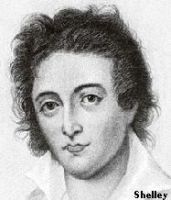
Percy Bysshe Shelley (August 4, 1792 – July 8, 1822)


Among the major English Romantic poets, Shelley is considered one of the finest lyric poets of the English language. He was married to the famous novelist Mary Shelley, author of Frankenstein.

On July 8, 1822, less than a month before his 30th birthday, Shelley drowned in a sudden storm off the coast of Italy. Shelley's body washed ashore and was cremated on the beach near Viareggio. He was later buried in Rome.


Some of my Shelley favorites:


Asia: From Prometheus Unbound

My soul is an enchanted boat,
Which, like a sleeping swan, doth float
Upon the silver waves of thy sweet singing;
And thine doth like an angel sit
Beside a helm conducting it,
Whilst all the winds with melody are ringing.
It seems to float ever, for ever,
Upon that many-winding river,
Between mountains, woods, abysses,
A paradise of wildernesses!
Till, like one in slumber bound,
Borne to the ocean, I float down, around,
Into a sea profound, of ever-spreading sound:

Meanwhile thy spirit lifts its pinions
In music's most serene dominions;
Catching the winds that fan that happy heaven.
And we sail on, away, afar,
Without a course, without a star,
But, by the instinct of sweet music driven;
Till through Elysian garden islets
By thee, most beautiful of pilots,
Where never mortal pinnace glided,
The boat of my desire is guided:
Realms where the air we breathe is love,
Which in the winds and on the waves doth move,
Harmonizing this earth with what we feel above.

We have past Age's icy caves,
And Manhood's dark and tossing waves,
And Youth's smooth ocean, smiling to betray:
Beyond the glassy gulfs we flee
Of shadow-peopled Infancy,
Through Death and Birth, to a diviner day;
A paradise of vaulted bowers,
Lit by downward-gazing flowers,
And watery paths that wind between
Wildernesses calm and green,
Peopled by shapes too bright to see,
And rest, having beheld; somewhat like thee;
Which walk upon the sea, and chant melodiously!


Love's Philosophy

The fountains mingle with the river
And the rivers with the ocean,
The winds of Heaven mix for ever
With a sweet emotion;
Nothing in the world is single,
All things by a law divine
In one spirit meet and mingle -
Why not I with thine?

See the mountains kiss high Heaven
And the waves clasp one another;
No sister-flower would be forgiven
If it disdained its brother;
And the sunlight clasps the earth,
And the moonbeams kiss the sea -
What are all these kissings worth
If thou kiss not me?


*note: I have always loved the mystery of the following

Ozymandias

I met a traveller from an antique land
Who said: "Two vast and trunkless legs of stone
Stand in the desert . . . Near them, on the sand,
Half sunk, a shattered visage lies, whose frown,
And wrinkled lip, and sneer of cold command,
Tell that its sculptor well those passions read
Which yet survive, stamped on these lifeless things,
The hand that mocked them, and the heart that fed:
And on the pedestal these words appear:
'My name is Ozymandias, king of kings:
Look on my works, ye Mighty, and despair!'
Nothing beside remains. Round the decay
Of that colossal wreck, boundless and bare
The lone and level sands stretch far away."


To Night

Swiftly walk over the western wave,
Spirit of Night!
Out of the misty eastern cave
Where, all the long and lone daylight,
Thou wovest dreams of joy and fear,
Which make thee terrible and dear, --
Swift be thy flight!

Wrap thy form in a mantle grey,
Star-inwrought!
Blind with thine hair the eyes of Day,
Kiss her until she be wearied out,
Then wander o'er city, and sea, and land,
Touching all with thine opiate wand --
Come, long-sought!

When I arose and saw the dawn,
I sighed for thee;
When light rode high, and the dew was gone,
And noon lay heavy on flower and tree,
And the weary Day turned to his rest,
Lingering like an unloved guest,
I sighed for thee.

Thy brother Death came, and cried
`Wouldst thou me?'
Thy sweet child Sleep, the filmy-eyed,
Murmured like a noontide bee
`Shall I nestle near thy side?
Wouldst thou me?' -- And I replied
`No, not thee!'

Death will come when thou art dead,
Soon, too soon --
Sleep will come when thou art fled;
Of neither would I ask the boon
I ask of thee, beloved Night --
Swift be thine approaching flight,
Come soon, soon!


– Cat    repost from 2006    

Sunday, December 10, 2023

Rupert Brooke


Rupert Brooke (August 3, 1887 – April 23, 1915) was a British poet best known for his idealistic, naively patriotic War Sonnets written during the First World War.


He entered the army as an officer, as befitted his social class, and took part in the Antwerp expedition in October 1914. He sailed with the British Mediterranean Expeditionary Force on February 28, 1915 but developed septic pneumonia from an infected mosquito bite. He died at 4.20pm on April 23, 1915 off the island of Lemnos in the Aegean on his way to a battle at Gallipoli. As the expeditionary force had orders to depart immediately, he was buried at 11pm in an olive grove on the island of Skyros, Greece. His grave remains there today. -- Wikipedia

He was 27 when he died.


These poems were written before 1914:


The Little Dog's Day

All in the town were still asleep,
When the sun came up with a shout and a leap.
In the lonely streets unseen by man,
A little dog danced. And the day began.

All his life he'd been good, as far as he could,
And the poor little beast had done all that he should.
But this morning he swore, by Odin and Thor
And the Canine Valhalla—he'd stand it no more!

So his prayer he got granted—to do just what he wanted,
Prevented by none, for the space of one day.
"Jam incipiebo, sedere facebo,"
In dog-Latin he quoth, "Euge! sophos! hurray!"

He fought with the he-dogs, and winked at the she-dogs,
A thing that had never been heard of before.
"For the stigma of gluttony, I care not a button!" he
Cried, and ate all he could swallow—and more.

He took sinewy lumps from the shins of old frumps,
And mangled the errand-boys—when he could get 'em.
He shammed furious rabies, and bit all the babies,
And followed the cats up the trees, and then ate 'em!"

They thought 'twas the devil was holding a revel,
And sent for the parson to drive him away;
For the town never knew such a hullabaloo
As that little dog raised—till the end of that day.

When the blood-red sun had gone burning down,
And the lights were lit in the little town,
Outside, in the gloom of the twilight grey,
The little dog died when he'd had his day.


The Hill

Breathless, we flung us on the windy hill,
Laughed in the sun, and kissed the lovely grass.
You said "Through glory and ecstasy we pass;
Wind, sun, and earth remain, and birds sing still,
When we are old, are old...." "And when we die
All's over that is ours; and life burns on
Through other lovers, other lips" said I,
"Heart of my heart, our heaven is now, is won!"

"We are Earth's best, that learnt her lesson here.
Life is our cry. We have kept the faith!" we said;
"We shall go down with unreluctant tread
Rose-crowned into the darkness!".... Proud we were,
And laughed, that had such brave true things to say.
—And then you suddenly cried, and turned away.


Heaven

Fish (fly-replete, in depth of June,
Dawdling away their wat'ry noon)
Ponder deep wisdom, dark or clear,
Each secret fishy hope or fear.
Fish say, they have their Stream and Pond;
But is there anything Beyond?
This life cannot be All, they swear,
For how unpleasant, if it were!
One may not doubt that, somehow, Good
Shall come of Water and of Mud;
And, sure, the reverent eye must see
A Purpose in Liquidity.
We darkly know, by Faith we cry,
The future is not Wholly Dry.
Mud unto mud! -- Death eddies near --
Not here the appointed End, not here!
But somewhere, beyond Space and Time.
Is wetter water, slimier slime!
And there (they trust) there swimmeth One
Who swam ere rivers were begun,
Immense, of fishy form and mind,
Squamous, omnipotent, and kind;
And under that Almighty Fin,
The littlest fish may enter in.
Oh! never fly conceals a hook,
Fish say, in the Eternal Brook,
But more than mundane weeds are there,
And mud, celestially fair;
Fat caterpillars drift around,
And Paradisal grubs are found;
Unfading moths, immortal flies,
And the worm that never dies.
And in that Heaven of all their wish,
There shall be no more land, say fish.


– Cat

Thursday, November 16, 2023

Walt Whitman


American poet Walt Whitman May 31, 1819 - March 26, 1892

Banned in Boston* and other cities because his books of poetry were considered obscene, offensive, pornographic by many straight-laced citizens of the era, he was a free spirit, original thinker, and revered by many--both while he lived and after he died.

*And of course sales went up, as they always do when this happens.

On April 14, 1865, Abraham Lincoln was assassinated. In honor of the beloved president, Whitman wrote the beautiful poem O Captain! My Captain!

I will admit the first time I heard this poem was in the movie Dead Poets Society. And I'll further admit that I wasn't familiar with the poet's name until on an episode of the television series Dr. Quinn, Medicine Woman the righteous townfolk wanted to burn his books.

I often wondered why I had never heard anything about or by this great poet. Hmm, I went to parochial schools. Maybe that explains it?


Some poems by Walt Whitman


O Captain! My Captain!

O Captain! my Captain! our fearful trip is done,
The ship has weathered every rack, the prize we sought is won,
The port is near, the bells I hear, the people all exulting,
While follow eyes the steady keel, the vessel grim and daring;
But O heart! heart! heart!
O the bleeding drops of red,
Where on the deck my Captain lies,
Fallen cold and dead.

O Captain! my Captain! rise up and hear the bells;
Rise up--for you the flag is flung--for you the bugle trills,
For you bouquets and ribboned wreaths--for you the shores a-crowding,
For you they call, the swaying mass, their eager faces turning;
Here Captain! dear father!
This arm beneath your head!
It is some dream that on the deck,
You've fallen cold and dead.

My Captain does not answer, his lips are pale and still;
My father does not feel my arm, he has no pulse nor will;
The ship is anchored safe and sound, its voyage closed and done;
From fearful trip the victor ship comes in with object won;
Exult O shores, and ring O bells!
But I, with mournful tread,
Walk the deck my Captain lies,
Fallen cold and dead.


O ME! O LIFE!

O ME! O life!…of the questions of these recurring;
Of the endless trains of the faithless—of cities fill'd with
the foolish;

Of myself forever reproaching myself, (for who more
foolish than I, and who more faithless?)

Of eyes that vainly crave the light—of the objects mean
—of the struggle ever renew'd;

Of the poor results of all—of the plodding and sordid
crowds I see around me;

Of the empty and useless years of the rest—with the
rest me intertwined;

The question, O me! so sad, recurring—What good
amid these, O me, O life?


Answer.
That you are here—that life exists, and identity;
That the powerful play goes on, and you will contribute
a verse.


TO THE READER AT PARTING.

Now, dearest comrade, lift me to your face,
We must separate awhile—Here! take from my lips
this kiss;

Whoever you are, I give it especially to you;
So long! —And I hope we shall meet again.


– Cat

Saturday, November 11, 2023

November 11 Remembering

 Remembrance Day originally commemorated the brave soldiers who fought and died in WWI. The Great War. The War to End All Wars.


Will there ever be a time of no war? Was there ever such a time?

I would like to honor all the young men and women who risk and give their lives for that shining ideal, that wish for peace, for a kinder, gentler world.

Perhaps in the next millennium...


Here are some works by poets of WWI, who sadly died in combat, much too young.


In Flanders Fields - by Royal Canadian Army Medical Corp officer, Dr. John McCrae [1872-1918]


In Flanders Fields
by John McCrae, written May 1915

In Flanders fields the poppies blow
Between the crosses, row on row,
That mark our place; and in the sky
The larks, still bravely singing, fly
Scarce heard amid the guns below.

We are the Dead. Short days ago
We lived, felt dawn, saw sunset glow,
Loved and were loved, and now we lie
In Flanders fields.

Take up our quarrel with the foe:
To you from failing hands we throw
The torch; be yours to hold it high.
If ye break faith with us who die
We shall not sleep,
though poppies grow
In Flanders fields.


~


Wilfred Edward Salter Owen (March 18, 1893 - November 4, 1918). English poet and soldier, regarded by some as the leading poet of the First World War. He died one week before the end of the war.


Anthem For Doomed Youth
by Wilfred Owen

What passing-bells for these who die as cattle?
Only the monstrous anger of the guns.
Only the stuttering rifles' rapid rattle
Can patter out their hasty orisons.
No mockeries for them; no prayers nor bells,
Nor any voice of mourning save the choirs,--
The shrill, demented choirs of wailing shells;
And bugles calling for them from sad shires.
What candles may be held to speed them all?
Not in the hands of boys, but in their eyes
Shall shine the holy glimmers of goodbyes.
The pallor of girls' brows shall be their pall;
Their flowers the tenderness of patient minds,
And each slow dusk a drawing-down of blinds.


Dulce Et Decorum Est Pro Patria Mori
by Wilfred Owen

Bent double, like old beggars under sacks,
Knock-kneed, coughing like hags, we cursed through sludge,
Till on the haunting flares we turned our backs,
And towards our distant rest began to trudge.
Men marched asleep. Many had lost their boots,
But limped on, blood-shod. All went lame, all blind;
Drunk with fatigue; deaf even to the hoots
Of gas-shells dropping softly behind.

Gas! GAS! Quick, boys!--An ecstasy of fumbling
Fitting the clumsy helmets just in time,
But someone still was yelling out and stumbling
And flound'ring like a man in fire or lime.--
Dim through the misty panes and thick green light,
As under a green sea, I saw him drowning.
In all my dreams before my helpless sight
He plunges at me, guttering, choking, drowning.

If in some smothering dreams, you too could pace
Behind the wagon that we flung him in,
And watch the white eyes writhing in his face,
His hanging face, like a devil's sick of sin,
If you could hear, at every jolt, the blood
Come gargling from the froth-corrupted lungs
Bitter as the cud
Of vile, incurable sores on innocent tongues,--
My friend, you would not tell with such high zest
To children ardent for some desperate glory,
The old Lie: Dulce et decorum est
Pro patria mori.

Note: Dulce et decorum est Pro Patria mori is from Horace. Owen wrote in a letter to his mother: "The famous Latin tag means of course It is sweet and fitting to die for one's country. Sweet! and decorous!"

Written in 1917


Futility
by Wilfred Owen

Move him into the sun-
Gently its touch awoke him once,
At home, whispering of fields unsown.
Always it woke him, even in France,
Until this morning and this snow.
If anything might rouse him now
The kind old sun will know.

Think how it wakes the seeds-
Woke once the clays of a cold star.
Are limbs, so dear-achieved, are sides
Full-nerved, still warm, too hard to stir?
Was it for this the clay grew tall?
-O what made fatuous sunbeams toil
To break earth's sleep at all?

Written in 1918.


The Next War
by Wilfred Owen

War's a joke for me and you,

While we know such dreams are true--Siegfried Sassoon

Out there, we've walked quite friendly up to Death;
Sat down an eaten with him, cool and bland, -
Pardoned his spilling mess-tins in our hand.
We've sniffed the green thick odour of his breath, -
Our eyes wept, but our courage didn't writhe.
He's spat at us with bullets and he's coughed
Shrapnel. We chorused when he sang aloft;
We whistled while he shaved us with his scythe.

Oh, Death was never enemy of ours!
We laughed at him, we leagued with him, old chum.
No soldier's paid to kick against his powers.
We laughed, knowing that better men would come,
And greater wars; when each proud fighter brags
He wars on Death - for lives; not men - for flags.


written 1915


--Cat

Friday, October 27, 2023

William Wordsworth

 William Wordsworth (1770-1850)  

Three poems by this prolific English poet. The first was written in 1804, a few years after the French Revolution (1789-99), when Emperor Napoleon was negating all the things the revolutionaries fought for.


The World is too much with us

The world is too much with us; late and soon,
Getting and spending, we lay waste our powers:
Little we see in Nature that is ours;
We have given our hearts away, a sordid boon!
This Sea that bares her bosom to the moon;
The winds that will be howling at all hours,
And are up-gathered now like sleeping flowers;
For this, for everything, we are out of tune;
It moves us not.--Great God! I'd rather be
A Pagan suckled in a creed outworn;
So might I, standing on this pleasant lea,
Have glimpses that would make me less forlorn;
Have sight of Proteus rising from the sea;
Or hear old Triton blow his wreathèd horn.

--William Wordsworth 1804


This poem is, I think, familiar to every schoolchild who took literature class. It's exuberant and happy, reminding us of the simple beauties of nature.


I Wandered Lonely as a Cloud

I wandered lonely as a cloud
That floats on high o'er vales and hills,
When all at once I saw a crowd,
A host, of golden daffodils;
Beside the lake, beneath the trees,
Fluttering and dancing in the breeze.

Continuous as the stars that shine
And twinkle on the milky way,
They stretched in never-ending line
Along the margin of a bay:
Ten thousand saw I at a glance,
Tossing their heads in sprightly dance.

The waves beside them danced; but they
Out-did the sparkling waves in glee:
A poet could not but be gay,
In such a jocund company:
I gazed--and gazed--but little thought
What wealth the show to me had brought:

For oft, when on my couch I lie
In vacant or in pensive mood,
They flash upon that inward eye
Which is the bliss of solitude;
And then my heart with pleasure fills,
And dances with the daffodils.

--William Wordsworth 1804 


My Heart Leaps Up

 My heart leaps up when I behold
 A rainbow in the sky:
 So was it when my life began;
 So is it now I am a man;
 So be it when I shall grow old,
 Or let me die!
 The Child is father of the Man;
 And I could wish my days to be
  Bound each to each by natural piety. 

– William Wordsworth 1802


– Cat