Sunday, February 25, 2007

Feb. 26 - Victor Hugo


Victor Marie Hugo - Feb. 26, 1802-May 22, 1885


Victor Hugo is considered the most important of the French Romantic writers. Poet, novelist, dramatist -- The Hunchback of Notre Dame and Les Misérables are among his best known works.

In 1827 he wrote that romanticism is the liberalism of literature.

His lyrical style has been described as 'rich, intense and full of powerful sounds and rhythms.

Hugo's funeral in 1885 was a national event, attended by two million people.


Some works by Victor Hugo:


A Sunset (From "Feuilles d'Automne")

I love the evenings, passionless and fair, I love the evens,
Whether old manor-fronts their ray with golden fulgence leavens,
In numerous leafage bosomed close;
Whether the mist in reefs of fire extend its reaches sheer,
Or a hundred sunbeams splinter in an azure atmosphere
On cloudy archipelagos.

Oh, gaze ye on the firmament! a hundred clouds in motion,
Up-piled in the immense sublime beneath the winds' commotion,
Their unimagined shapes accord:
Under their waves at intervals flame a pale levin through,
As if some giant of the air amid the vapors drew
A sudden elemental sword.

The sun at bay with splendid thrusts still keeps the sullen fold;
And momently at distance sets, as a cupola of gold,
The thatched roof of a cot a-glance;
Or on the blurred horizon joins his battle with the haze;
Or pools the blooming fields about with inter-isolate blaze,
Great moveless meres of radiance.

Then mark you how there hangs athwart the firmament's swept track,
Yonder a mighty crocodile with vast irradiant back,
A triple row of pointed teeth?
Under its burnished belly slips a ray of eventide,
The flickerings of a hundred glowing clouds in tenebrous side
With scales of golden mail ensheathe.

Then mounts a palace, then the air vibrates--the vision flees.
Confounded to its base, the fearful cloudy edifice
Ruins immense in mounded wrack;
Afar the fragments strew the sky, and each envermeiled cone
Hangeth, peak downward, overhead, like mountains overthrown
When the earthquake heaves its hugy back.

These vapors, with their leaden, golden, iron, bronzèd glows,
Where the hurricane, the waterspout, thunder, and hell repose,
Muttering hoarse dreams of destined harms,--
'Tis God who hangs their multitude amid the skiey deep,
As a warrior that suspendeth from the roof-tree of his keep
His dreadful and resounding arms!

All vanishes! The Sun, from topmost heaven precipitated,
Like a globe of iron which is tossed back fiery red
Into the furnace stirred to fume,
Shocking the cloudy surges, plashed from its impetuous ire,
Even to the zenith spattereth in a flecking scud of fire
The vaporous and inflamèd spaume.

O contemplate the heavens! Whenas the vein-drawn day dies pale,
In every season, every place, gaze through their every veil?
With love that has not speech for need!
Beneath their solemn beauty is a mystery infinite:
If winter hue them like a pall, or if the summer night
Fantasy them starre brede.

Translated by Francis Thompson (1859-1907).


More Strong Than Time

Since I have set my lips to your full cup, my sweet,
Since I my pallid face between your hands have laid,
Since I have known your soul, and all the bloom of it,
And all the perfume rare, now buried in the shade;

Since it was given to me to hear on happy while,
The words wherein your heart spoke all its mysteries,
Since I have seen you weep, and since I have seen you smile,
Your lips upon my lips, and your eyes upon my eyes;

Since I have known above my forehead glance and gleam,
A ray, a single ray, of your star, veiled always,
Since I have felt the fall, upon my lifetime's stream,
Of one rose petal plucked from the roses of your days;

I now am bold to say to the swift changing hours,
Pass, pass upon your way, for I grow never old,
Fleet to the dark abysm with all your fading flowers,
One rose that none may pluck, within my heart I hold.

Your flying wings may smite, but they can never spill
The cup fulfilled of love, from which my lips are wet;
My heart has far more fire than you can frost to chill,
My soul more love than you can make my soul forget.

Translated by Andrew Lang (1844-1912).


The Genesis of Butterflies

The dawn is smiling on the dew that covers
The tearful roses; lo, the little lovers
That kiss the buds, and all the flutterings
In jasmine bloom, and privet, of white wings,
That go and come, and fly, and peep and hide,
With muffled music, murmured far and wide.
Ah, the Spring time, when we think of all the lays
That dreamy lovers send to dreamy mays,
Of the fond hearts within a billet bound,
Of all the soft silk paper that pens wound,
The messages of love that mortals write
Filled with intoxication of delight,
Written in April and before the May time
Shredded and flown, playthings for the wind's playtime,
We dream that all white butterflies above,
Who seek through clouds or waters souls to love,
And leave their lady mistress in despair,
To flit to flowers, as kinder and more fair,
Are but torn love-letters, that through the skies
Flutter, and float, and change to butterflies.

Translated by Andrew Lang (1844-1912).


The Poor Children

Take heed of this small child of earth;
He is great; he hath in him God most high.
Children before their fleshly birth
Are lights alive in the blue sky.

In our light bitter world of wrong
They come; God gives us them awhile.
His speech is in their stammering tongue,
And his forgiveness in their smile.

Their sweet light rests upon our eyes.
Alas! their right to joy is plain.
If they are hungry Paradise
Weeps, and, if cold, Heaven thrills with pain.

The want that saps their sinless flower
Speaks judgment on sin's ministers.
Man holds an angel in his power.
Ah! deep in Heaven what thunder stirs,

When God seeks out these tender things
Whom in the shadow where we sleep
He sends us clothed about with wings,
And finds them ragged babes that weep!

Translated by Algernon Charles Swinburne (1837-1909).


-- Cat

Monday, February 12, 2007

Feb 12 - George Meredith


George Meredith (Feb 12, 1828- May 18, 1909)

Victorian poet and novelist, influential in his time.

Some of his works:


Dirge in Woods

A wind sways the pines,
And below
Not a breath of wild air;
Still as the mosses that glow
On the flooring and over the lines
Of the roots here and there.
The pine-tree drops its dead;
They are quiet, as under the sea.
Overhead, overhead
Rushes life in a race,
As the clouds the clouds chase;
And we go,
And we drop like the fruits of the tree,
Even we,
Even so.

First publication date: 1870


Lucifer in Starlight

On a starred night Prince Lucifer uprose.
Tired of his dark dominion swung the fiend
Above the rolling ball in cloud part screened,
Where sinners hugged their spectre of repose.
Poor prey to his hot fit of pride were those.
And now upon his western wing he leaned,
Now his huge bulk o'er Afric's sands careened,
Now the black planet shadowed Arctic snows.
Soaring through wider zones that pricked his scars
With memory of the old revolt from Awe,
He reached a middle height, and at the stars,
Which are the brain of heaven, he looked, and sank.
Around the ancient track marched, rank on rank,
The army of unalterable law.


First publication date: 1883


Modern Love: I

By this he knew she wept with waking eyes:
That, at his hand's light quiver by her head,
The strange low sobs that shook their common bed
Were called into her with a sharp surprise,
And strangled mute, like little gaping snakes,
Dreadfully venomous to him. She lay
Stone-still, and the long darkness flowed away
With muffled pulses. Then, as midnight makes
Her giant heart of Memory and Tears
Drink the pale drug of silence, and so beat
Sleep's heavy measure, they from head to feet
Were moveless, looking through their dead black years,
By vain regret scrawled over the blank wall.
Like sculptured effigies they might be seen
Upon their marriage-tomb, the sword between;
Each wishing for the sword that severs all.

Note: This is the first of fifty sixteen-line sonnets thought influenced by the unhappy history of Meredith's unsuccessful first marriage.


First publication date: 1862


Thursday, January 25, 2007

Robert Burns


January 25, 1759 – July 21, 1796


My Heart's In The Highlands
by Robert Burns

Farewell to the Highlands, farewell to the North,
The birth-place of Valour, the country of Worth;
Wherever I wander, wherever I rove,
The hills of the Highlands for ever I love.

My heart's in the Highlands, my heart is not here;
My heart's in the Highlands a-chasing the deer;
A-chasing the wild-deer, and following the roe,
My heart's in the Highlands wherever I go.

Farewell to the mountains high covered with snow;
Farewell to the straths and green valleys below;
Farewell to the forests and wild-hanging woods;
Farewell to the torrents and loud-pouring floods.

My heart's in the Highlands, my heart is not here;
My heart's in the Highlands a-chasing the deer;
A-chasing the wild-deer, and following the roe,
My heart's in the Highlands wherever I go.

1789

Wednesday, January 10, 2007

January 10 -- Robinson Jeffers


Robinson Jeffers, photograph by Carl Van Vechten, July 9, 1937


Robinson Jeffers January 10, 1887 - January 20, 1962


My favorite poet. I always seem to return to those of his works that make a statement about the world, as he saw it during his lifetime, and as it is today.

From The Academy of American Poets:

Jeffers brought enormous learning in literature, religion, philosophy, languages, myth, and sciences to his poetry. One of his favorite themes was the intense, rugged beauty of the landscape in opposition to the degraded and introverted condition of modern man. Strongly influenced by Nietzsche's concepts of individualism, Jeffers believed that human beings had developed an insanely self-centered view of the world, and felt passionately that we must learn to have greater respect for the rest of creation.


Some works by Jeffers:


The Purse-Seine
by Robinson Jeffers (1937)


Our sardine fishermen work at night in the dark
of the moon; daylight or moonlight
They could not tell where to spread the net,
unable to see the phosphorescence of the
shoals of fish.
They work northward from Monterey, coasting
Santa Cruz; off New Year's Point or off
Pigeon Point
The look-out man will see some lakes of milk-color
light on the sea's night-purple; he points,
and the helmsman
Turns the dark prow, the motorboat circles the
gleaming shoal and drifts out her seine-net.
They close the circle
And purse the bottom of the net, then with great
labor haul it in.

I cannot tell you
How beautiful the scene is, and a little terrible,
then, when the crowded fish
Know they are caught, and wildly beat from one wall
to the other of their closing destiny the
phosphorescent
Water to a pool of flame, each beautiful slender body
sheeted with flame, like a live rocket
A comet's tail wake of clear yellow flame; while outside
the narrowing
Floats and cordage of the net great sea-lions come up
to watch, sighing in the dark; the vast walls
of night
Stand erect to the stars.

Lately I was looking from a night mountain-top
On a wide city, the colored splendor, galaxies of light:
how could I help but recall the seine-net
Gathering the luminous fish? I cannot tell you how
beautiful the city appeared, and a little terrible.
I thought, We have geared the machines and locked all together
into inter-dependence; we have built the great cities; now
There is no escape. We have gathered vast populations incapable
of free survival, insulated
From the strong earth, each person in himself helpless, on all
dependent. The circle is closed, and the net
Is being hauled in. They hardly feel the cords drawing, yet
they shine already. The inevitable mass-disasters
Will not come in our time nor in our children's, but we
and our children
Must watch the net draw narrower, government take all
powers--or revolution, and the new government
Take more than all, add to kept bodies kept souls--or anarchy,
the mass-disasters.

These things are Progress;

Do you marvel our verse is troubled or frowning, while it keeps
its reason? Or it lets go, lets the mood flow
In the manner of the recent young men into mere hysteria,
splintered gleams, crackled laughter. But they are
quite wrong.
There is no reason for amazement: surely one always knew
that cultures decay, and life's end is death.


Wise Men In Their Bad Hours
by Robinson Jeffers

Wise men in their bad hours have envied
The little people making merry like grasshoppers
In spots of sunlight, hardly thinking
Backward but never forward, and if they somehow
Take hold upon the future they do it
Half asleep, with the tools of generation
Foolishly reduplicating
Folly in thirty-year periods; they eat and laugh too,
Groan against labors, wars and partings,
Dance, talk, dress and undress; wise men have pretended
The summer insects enviable;
One must indulge the wise in moments of mockery.
Strength and desire possess the future,
The breed of the grasshopper shrills, "What does the future
Matter, we shall be dead?" Ah, grasshoppers,
Death's a fierce meadowlark: but to die having made
Something more equal to the centuries
Than muscle and bone, is mostly to shed weakness.
The mountains are dead stone, the people
Admire or hate their stature, their insolent quietness,
The mountains are not softened nor troubled
And a few dead men's thoughts have the same temper.


Natural Music
by Robinson Jeffers

The old voice of the ocean, the bird-chatter of little rivers,
(Winter has given them gold for silver
To stain their water and bladed green for brown to line their banks)
From different throats intone one language.
So I believe if we were strong enough to listen without
Divisions of desire and terror
To the storm of the sick nations, the rage of the hunger smitten cities,
Those voices also would be found
Clean as a child's; or like some girl's breathing who dances alone
By the ocean-shore, dreaming of lovers.


-- Cat

Saturday, December 30, 2006

Happy 2007!


May 2007 be better than 2006.

Nothing says it as good as the traditional --

Auld Lang Syne

by Robert Burns

1788

Should auld acquaintance be forgot,
And never brought to mind?
Should auld acquaintance be forgot,
And auld lang syne!

Chorus.-For auld lang syne, my dear,
For auld lang syne.
We'll tak a cup o' kindness yet,
For auld lang syne.

And surely ye'll be your pint stowp!
And surely I'll be mine!
And we'll tak a cup o'kindness yet,
For auld lang syne.

Chorus --

We twa hae run about the braes,
And pou'd the gowans fine;
But we've wander'd mony a weary fit,
Sin' auld lang syne.

Chorus --

We twa hae paidl'd in the burn,
Frae morning sun till dine;
But seas between us braid hae roar'd
Sin' auld lang syne.

Chorus --

And there's a hand, my trusty fere!
And gie's a hand o' thine!
And we'll tak a right gude-willie waught,
For auld lang syne.

Chorus --

Monday, December 18, 2006

Christmas Ghosts

When I was a child I loved the story of the Nativity. Observant, if not devout, Catholics, we always had a crèche under the Christmas tree. I remember most of the words to the carols we sang with the choir. My favorite carol O Holy Night, closely followed by O Come, O Come Emmanuel, represents a time that no longer exists.

These days I neither believe nor doubt. But I like to think, as I did when young, that there is one night filled with Peace on Earth and Good Will Toward Men.


I wrote Joseph's Lament because I felt he was usually the forgotten one in the story. It was published in The Poet's Pen in 1993.


Joseph's Lament

What meager harvest do I reap?
This fragile infant, now asleep,
a sickly child, so small and wan,
I doubt he'll live to see the dawn.
Born in darkness, much too soon
after the solstice marks the ruin
of winter. Born in darkness vast
when harvest days are well long past.

The Son of God? I hear no mirth,
no angel choirs announce this birth.
There is no music at this show,
only bitter winds that blow.
The Son of God? So weak and pale.
Would He not sire one more hale?
A fitting child of robust mold,
a child of beauty to behold?


Would not God's Son be born in spring
in a palace grand as befits a king?
Not in this dank stable stall
where winds seep through cracks in the wall,
attended by one sad-eyed cow.
No miracle, this, for I see now
the child was born in a mortal vein,
brought his mother suffering and pain.

They say a humble man am I,
what piety, what faith I ply.
I'm not a beggar, not blind, nor lame.
I seek not riches, gold, nor fame,
and so I've never asked for such.
My simple life has pleased me much.
Humble I am, but not a fool.
Must my faith be stretched so cruel?

Without a moon or stars to mark
the way, I stumble in the dark
and wrestle with impious doubt,
praying my Lord will bear me out.
Am I now punished for my false pride?
Did I raise myself above the tide
with arrogant thoughts that I was the one
chosen by God to foster his Son?

What now? Who are these simple folks?
They have no shoes, no hats, no cloaks.
Have forces strange drawn shepherds poor
down from the hills to the stable door
where Mary and her son both lie?
More likely they are as cold as I.
They do not speak, and yet I sense
their awe-struck, wondering eloquence.

Now, mysteriously, stars appear
as if the hand of God were near.
But no. My mind is playing tricks.
'Tis foolishness, and yet, it sticks.
The stable bathes in silver light,
even within the dark takes flight.
The shadows have dispersed, and all
the shepherds to their knees do fall.

The infant wakes and this sweet haze
reveals his fairness to my gaze.
He cannot see me, this I know,
and yet his eyes hold mine, and glow.
He lifts his hand, a hand so small
which soon will hold the world in thrall.
Compelled, I lightly touch his face,
and feel his wondrous strength and grace.

Amazed, I look upon my wife.
She smiles. She knows that this small life
will someday save mankind from doom.
My soul does like a flower bloom
and I must brush my tears away,
knowing He must die one day.
The sun now heralds a bright new morn.
Behold! The Son of God is born.


--© Cat Dubie -- 2006

Wednesday, December 13, 2006

Dec. 13 - Heinrich Heine


Painting by Moritz Daniel Oppenheim

Christian Johann Heinrich Heine (born Chaim Harry Heine)
December 13, 1797 – February 17, 1856

Heinrich Heine, of Jewish origin, was one of the most significant of the German poets. His lyrics inspired such composers as Mendelssohn, Schubert, and Schumann, and his poem 'Die Lorelei', set to music in 1837, has become a lastingly popular German song.

One of his most famous quotes, though it originally referred to the Spanish Inquisition, proved prophetic regarding events more than 100 years after his death:

Where they have burned books, they will end in burning human beings.
(Dort, wo man Bücher verbrennt, verbrennt man am Ende auch Menschen)

Heinrich Heine, From his play Almansor (1821)


Some works by Heinrich Heine


Death and his Brother Sleep (‘Morphine’)

There’s a mirror likeness between those two
shining, youthfully-fledged figures, though
one seems paler than the other and more austere,
I might even say more perfect, more distinguished,
than he, who would take me confidingly in his arms –
how soft then and loving his smile, how blessed his glance!
Then, it might well have been that his wreath
of white poppies gently touched my forehead, at times,
and drove the pain from my mind with its strange scent.
But that is transient. I can only, now, be well,
when the other one, so serious and pale,
the older brother, lowers his dark torch. –
Sleep is so good, Death is better, yet
surely never to have been born is best.


A Palm-tree

A single fir-tree, lonely,
on a northern mountain height,
sleeps in a white blanket,
draped in snow and ice.

His dreams are of a palm-tree,
who, far in eastern lands,
weeps, all alone and silent,
among the burning sands.


The Old Dream Comes Again to Me

The old dream comes again to me:
With May-night stars above,
We two sat under the linden-tree
And swore eternal love.

Again and again we plighted troth,
We chattered, and laughed, and kissed;
To make me well remember my oath
You gave me a bite on the wrist.

O darling with the eyes serene,
And with the teeth so white!
The vows were proper to the scene,
Superfluous was the bite.


Prologue

Good-Fortune is a giddy maid,
Fickle and restless as a fawn;
She smoothes your hair; and then the jade
Kisses you quickly, and is gone.

But Madam Sorrow scorns all this,
She shows no eagerness for flitting;
But, with a long and fervent kiss,
Sits by your bed—and brings her knitting.


The Voyage

As at times a moonbeam pierces
Through the thickest cloudy rack,
So to me, through days so dreary,
One bright image struggles back.

Seated all on deck, we floated
Down the Rhine's majestic stream;
On its borders, summer-laden,
Slept the peaceful evening-gleam.

Brooding, at the feet I laid me
Of a fair and gentle one,
On whose placid, pallid features
Played the ruddy-golden sun.

Lutes were ringing, youths were singing,
Swelled my heart with feeling strange;
Bluer grew the heaven above us,
Wider grew the spirit's range.

Fairy-like beside us flitted
Rock and ruin, wood and plain ;
And I gazed on all reflected
In my loved one's eyes again.


Where?

Where shall I, of wandering weary,
Find my resting-place at last?
Under drooping southern palm-trees?
Under limes the Rhine sweeps past?

Will it be in deserts lonely,
Dug by unfamiliar hands?
Shall I slumber where the ocean
Crawls along the yellow sands?

It matters not! Around me ever
There as here God's heaven lies,
And by night, as death-lamps o'er me,
Lo, His stars sweep through the skies!


The Lorelei (Die Lorelei - translated by A Z Foreman)

I know not if there is a reason
Why I am so sad at heart.
A legend of bygone ages
Haunts me and will not depart.

The air is cool under nightfall.
The calm Rhine courses its way.
The peak of the mountain is sparkling
With evening's final ray.

The fairest of maidens is sitting
Unwittingly wondrous up there,
Her golden jewels are shining,
She's combing her golden hair.

The comb she holds is golden,
She sings a song as well
Whose melody binds an enthralling
And overpowering spell.

In his little boat, the boatman
Is seized with a savage woe,
He'd rather look up at the mountain
Than down at the rocks below.

I think that the waves will devour
The boatman and boat as one;
And this by her song's sheer power
Fair Lorelei has done.

Original:

Ich weiß nicht, was soll es bedeuten,

Daß ich so traurig bin;
Ein Märchen aus alten Zeiten,
Das kommt mir nicht aus dem Sinn.

Die Luft ist kühl, und es dunkelt,
Und ruhig fließt der Rhein;
Der Gipfel des Berges funkelt
In Abendsonnenschein.

Die schönste Jungfrau sitzet
Dort oben wunderbar,
Ihr goldenes Geschmeide blitzet,
Sie kämmt ihr goldenes Haar.

Sie kämmt es mit goldenem Kamme
Und singt ein Lied dabei;
Das hat eine wundersame,
Gewaltige Melodei.

Den Schiffer im kleinen Schiffe
Ergreift es mit wildem Weh;
Er schaut nicht die Felsenriffe,
Er schaut nur hinauf in die Höh'.

Ich glaube, die Wellen verschlingen
Am Ende Schiffer und Kahn;
Und das hat mit ihrem Singen
Die Lorelei getan.

--Cat

Monday, November 27, 2006

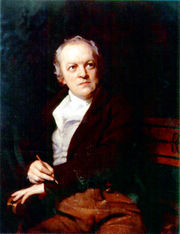
Nov. 28 - William Blake


William Blake (November 28, 1757–August 12, 1827) was an English poet, painter, and engraver. Largely unrecognised during his lifetime, his works of poetry and art are today considered significant contributions in their fields. Often noted a the most spiritual writer of his time, he was fascinated by mysticism and influenced by the emerging Romantic movement. Though hostile to the church, he had affection for the New Testament of the Bible.

During the 1780s he associated with intellectual dissidents: philosophers, writers, scientists, feminists. Blake supported the American and, initially, the French revolutions. He abhorred slavery and believed in racial and sexual equality. Several of his poems and paintings express a notion of universal humanity.

~

How many of us as students learned the following:

The Tyger

Tyger Tyger. burning bright,
In the forests of the night;
What immortal hand or eye.
Could frame thy fearful symmetry?

In what distant deeps or skies.
Burnt the fire of thine eyes?
On what wings dare he aspire?
What the hand, dare seize the fire?

And what shoulder, & what art,
Could twist the sinews of thy heart?
And when thy heart began to beat.
What dread hand? & what dread feet?

What the hammer? what the chain,
In what furnace was thy brain?
What the anvil? what dread grasp.
Dare its deadly terrors clasp?

When the stars threw down their spears
And watered heaven with their tears:
Did he smile His work to see?
Did he who made the lamb make thee?

Tyger Tyger burning bright,
In the forests of the night:
What immortal hand or eye,
Dare frame thy fearful symmetry?


~

I add this intriguing work, of which lines have often been quoted:


Auguries Of Innocence

To see a world in a grain of sand
And a heaven in a wild flower,
Hold infinity in the palm of your hand
And eternity in an hour.
A robin redbreast in a cage
Puts all heaven in a rage.
A dove-house filled with doves and pigeons
Shudders hell through all its regions.
A dog starved at his master's gate
Predicts the ruin of the state.
A horse misused upon the road
Calls to heaven for human blood.
Each outcry of the hunted hare
A fibre from the brain does tear.
A skylark wounded in the wing,
A cherubim does cease to sing.
The game-cock clipped and armed for fight
Does the rising sun affright.
Every wolf's and lion's howl
Raises from hell a human soul.
The wild deer wandering here and there
Keeps the human soul from care.
The lamb misused breeds public strife,
And yet forgives the butcher's knife.
The bat that flits at close of eve
Has left the brain that won't believe.
The owl that calls upon the night
Speaks the unbeliever's fright.
He who shall hurt the little wren
Shall never be beloved by men.
He who the ox to wrath has moved
Shall never be by woman loved.
The wanton boy that kills the fly
Shall feel the spider's enmity.
He who torments the chafer's sprite
Weaves a bower in endless night.
The caterpillar on the leaf
Repeats to thee thy mother's grief.
Kill not the moth nor butterfly,
For the Last Judgment draweth nigh.
He who shall train the horse to war
Shall never pass the polar bar.
The beggar's dog and widow's cat,
Feed them, and thou wilt grow fat.
The gnat that sings his summer's song
Poison gets from Slander's tongue.
The poison of the snake and newt
Is the sweat of Envy's foot.
The poison of the honey-bee
Is the artist's jealousy.
The prince's robes and beggar's rags
Are toadstools on the miser's bags.
A truth that's told with bad intent
Beats all the lies you can invent.
It is right it should be so:
Man was made for joy and woe;
And when this we rightly know
Through the world we safely go.
Joy and woe are woven fine,
A clothing for the soul divine.
Under every grief and pine
Runs a joy with silken twine.
The babe is more than swaddling bands,
Throughout all these human lands;
Tools were made and born were hands,
Every farmer understands.
Every tear from every eye
Becomes a babe in eternity;
This is caught by females bright
And returned to its own delight.
The bleat, the bark, bellow, and roar
Are waves that beat on heaven's shore.
The babe that weeps the rod beneath
Writes Revenge! in realms of death.
The beggar's rags fluttering in air
Does to rags the heavens tear.
The soldier armed with sword and gun
Palsied strikes the summer's sun.
The poor man's farthing is worth more
Than all the gold on Afric's shore.
One mite wrung from the labourer's hands
Shall buy and sell the miser's lands,
Or if protected from on high
Does that whole nation sell and buy.
He who mocks the infant's faith
Shall be mocked in age and death.
He who shall teach the child to doubt
The rotting grave shall ne'er get out.
He who respects the infant's faith
Triumphs over hell and death.
The child's toys and the old man's reasons
Are the fruits of the two seasons.
The questioner who sits so sly
Shall never know how to reply.
He who replies to words of doubt
Doth put the light of knowledge out.
The strongest poison ever known
Came from Caesar's laurel crown.
Nought can deform the human race
Like to the armour's iron brace.
When gold and gems adorn the plough
To peaceful arts shall Envy bow.
A riddle or the cricket's cry
Is to doubt a fit reply.
The emmet's inch and eagle's mile
Make lame philosophy to smile.
He who doubts from what he sees
Will ne'er believe, do what you please.
If the sun and moon should doubt,
They'd immediately go out.
To be in a passion you good may do,
But no good if a passion is in you.
The whore and gambler, by the state
Licensed, build that nation's fate.
The harlot's cry from street to street
Shall weave old England's winding sheet.
The winner's shout, the loser's curse,
Dance before dead England's hearse.
Every night and every morn
Some to misery are born.
Every morn and every night
Some are born to sweet delight.
Some are born to sweet delight,
Some are born to endless night.
We are led to believe a lie
When we see not through the eye
Which was born in a night to perish in a night,
When the soul slept in beams of light.
God appears, and God is light
To those poor souls who dwell in night,
But does a human form display
To those who dwell in realms of day.


--William Blake


Sunday, November 19, 2006

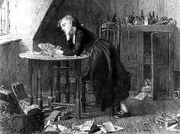
Nov. 20 - Thomas Chatterton


English poet Thomas Chatterton (November 20, 1752 – August 24, 1770) committed suicide by drinking arsenic rather than die of starvation at the young age of 17.

This gifted, rebellious youth became known for his genius after his death and later became a hero to the romantic poets.

These were written when he was 17 or younger!

Picture of Autumn

When autumn, bleak and sun-burnt, do appear,
With his gold hand gilting the falling leaf,
Bringing up winter to fulfil the year,
Bearing upon his back the riped sheaf;
When all the hills with woody seed are white,
When levying fires, and lemes, do meet from far the sight:
When the fair apple, rudde as even sky,
Do bend the tree unto the fructile ground.
When juicy pears, and berries of black dye,
Do dance in air and call the eyne around;
Then, be the even foul, or even fair,
Methinks my hearte's joy is stained with some care.


The Copernican System

The Sun revolving on his axis turns,
And with creative fire intensely burns;
Impell'd by forcive air, our Earth supreme,
Rolls with the planets round the solar gleam.
First Mercury completes his transient year,
Glowing, refulgent, with reflected glare;
Bright Venus occupies a wider way,
The early harbinger of night and day;
More distant still our globe terraqueous turns,
Nor chills intense, nor fiercely heated burns;
Around her rolls the lunar orb of light,
Trailing her silver glories through the night:
On the Earth's orbit see the various signs,
Mark where the Sun our year completing shines;
First the bright Ram his languid ray improves;
Next glaring watry thro' the Bull he moves;
The am'rous Twins admit his genial ray;
Now burning thro' the Crab he takes his way;
The Lion flaming bears the solar power;
The Virgin faints beneath the sultry show'r,
Now the just Balance weighs his equal force,
The slimy Serpent swelters in his course;
The sabled Archer clouds his languid face;
The Goat, with tempests, urges on his race;
Now in the Wat'rer his faint beams appear,
And the cold Fishes end the circling year.
Beyond our globe the sanguine Mars displays
A strong reflection of primoeval rays;
Next belted Jupiter far distant gleams,
Scarcely enlighten'd with the solar beams,
With four unfix'd receptacles of light,
He tours majestic thro' the spacious height:
But farther yet the tardy Saturn lags,
And five attendant Luminaries drags,
Investing with a double ring his pace,
He circles thro' immensity of space.
These are thy wondrous works, first source of Good!
Now more admir'd in being understood.


The Romance Of The Knight

The pleasing sweets of spring and summer past,
The falling leaf flies in the sultry blast,
The fields resign their spangling orbs of gold,
The wrinkled grass its silver joys unfold,
Mantling the spreading moor in heavenly white,
Meeting from every hill the ravished sight.
The yellow flag uprears its spotted head,
Hanging regardant o'er its watery bed;
The worthy knight ascends his foaming steed,
Of size uncommon, and no common breed.
His sword of giant make hangs from his belt,
Whose piercing edge his daring foes had felt.
To seek for glory and renown he goes
To scatter death among his trembling foes;
Unnerved by fear, they trembled at his stroke;
So cutting blasts shake the tall mountain oak.


Down in a dark and solitary vale,
Where the curst screech-owl sings her fatal tale,
Where copse and brambles interwoven lie,
Where trees intwining arch the azure sky,
Thither the fate-marked champion bent his way,
By purling streams to lose the heat of day;
A sudden cry assaults his listening ear,
His soul's too noble to admit of fear.—
The cry re-echoes; with his bounding steed
He gropes the way from whence the cries proceed.
The arching trees above obscured the light,
Here 'twas all evening, there eternal night.
And now the rustling leaves and strengthened cry
Bespeaks the cause of the confusion nigh;
Through the thick brake th'astonished champion sees
A weeping damsel bending on her knees:
A ruffian knight would force her to the ground,
But still some small resisting strength she found.
(Women and cats, if you compulsion use,
The pleasure which they die for will refuse.)
The champion thus: "Desist, discourteous knight,
Why dost thou shamefully misuse thy might?"
With eye contemptuous thus the knight replies,
"Begone! whoever dares my fury dies!"
Down to the ground the champion's gauntlet flew,
"I dare thy fury, and I'll prove it too."


Like two fierce mountain-boars enraged they fly,
The prancing steeds make Echo rend the sky,
Like a fierce tempest is the bloody fight,
Dead from his lofty steed falls the proud ruffian knight.
The victor, sadly pleased, accosts the dame,
"I will convey you hence to whence you came."
With look of gratitude the fair replied—
"Content; I in your virtue may confide.
But," said the fair, as mournful she surveyed
The breathless corse upon the meadow laid,
"May all thy sins from heaven forgiveness find!
May not thy body's crimes affect thy mind!"


Notes
This is a modernized version by Chatterton From "The Romaunte of the Knyghte, by medival poet John de Burgham."


Cat