Monday, October 30, 2006

Oct. 31 John Keats


One of the great Romantic Poets, John Keats was born in London on October 31, 1795. He died in Rome of tuberculosis at the age of 25, on February 23, 1821.

Keats told his friend Joseph Severn that he wanted on his grave just the line, "Here lies one whose name was writ in water."

Percy Bysshe Shelley, who admired Keats' work, celebrated Keats' greatness in his magnificent long elegy, Adonais --

He has outsoared the shadow of the night;
Envy and calumny and hate and pain,
And that unrest which men miscall delight,
Can touch him not and torture not again.


--excerpt from Adonais by Percy Bysshe Shelley

Best known perhaps for his beautiful Odes (To a Nightingale, On a Grecian Urn...), here are some sonnets by Keats:

When I Have Fears that I may Cease to be

When I have fears that I may cease to be
Before my pen has glean’d my teeming brain,
Before high piled books, in charact’ry,
Hold like rich garners the full-ripen’d grain;
When I behold, upon the night’s starr’d face,
Huge cloudy symbols of a high romance,
And think that I may never live to trace
Their shadows, with the magic hand of chance;
And when I feel, fair creature of an hour!
That I shall never look upon thee more,
Never have relish in the faery power
Of unreflecting love!—then on the shore
Of the wide world I stand alone, and think
Till Love and Fame to nothingness do sink.


Bright Star, Would I Were Steadfast As Thou Art

Bright star, would I were steadfast as thou art—
Not in lone splendour hung aloft the night
And watching, with eternal lids apart,
Like nature's patient, sleepless Eremite,
The moving waters at their priestlike task
Of pure ablution round earth's human shores,
Or gazing on the new soft-fallen mask
Of snow upon the mountains and the moors—
No—yet still steadfast, still unchangeable,
Pillow'd upon my fair love's ripening breast,
To feel for ever its soft fall and swell,
Awake for ever in a sweet unrest,
Still, still to hear her tender-taken breath,
And so live ever—or else swoon to death.


O Solitude! If I Must With Thee Dwell

O Solitude! if I must with thee dwell,
Let it not be among the jumbled heap
Of murky buildings: climb with me the steep,—
Nature's observatory—whence the dell,
In flowery slopes, its river's crystal swell,
May seem a span; let me thy vigils keep
'Mongst boughs pavilioned, where the deer's swift leap
Startles the wild bee from the foxglove bell.
But though I'll gladly trace these scenes with thee,
Yet the sweet converse of an innocent mind,
Whose words are images of thoughts refined,
Is my soul's pleasure; and it sure must be
Almost the highest bliss of human-kind,
When to thy haunts two kindred spirits flee.

--John Keats

~

Cat

Saturday, October 21, 2006

Oct 21 - Coleridge


Samuel Taylor Coleridge October 21, 1772 - July 25, 1834

Coleridge, with all his talent, was never able to get his life together. Plagued by poor health, he began using laudanum, then progressed to opium, which became a lifelong addiction.

Best known for his poetry, eg The Rime of the Ancient Mariner, he was a brilliant essayist and critic. He was considered the greatest Shakespeare critic.

Often on the verge of suicide, he sums up his life in the epitaph he wrote for himself:

Stop, Christian passer-by : Stop, child of God,
And read, with gentle breast. Beneath this sod
A poet lies, or that which once seem'd he--
O, lift one thought in prayer for S. T. C.--
That he who many a year with toil of breath
Found death in life, may here find life in death:
Mercy for praise--to be forgiven for fame--
He ask'd, and hoped through Christ. Do thou the same.

Nov. 9, 1833.


Epigram

Sir, I admit your general rule,
That every poet is a fool,
But you yourself may serve to show it,
That every fool is not a poet.


~said to have been the result of a opium dream:

Kubla Khan (1797)

In Xanadu did Kubla Khan
A stately pleasure-dome decree:
Where Alph, the sacred river, ran
Through caverns measureless to man
Down to a sunless sea.

So twice five miles of fertile ground
With walls and towers were girdled round:
And there were gardens bright with sinuous rills,
Where blossomed many an incense-bearing tree;
And here were forests ancient as the hills,
Enfolding sunny spots of greenery.

But oh! that deep romantic chasm which slanted
Down the green hill athwart a cedarn cover!
A savage place! as holy and enchanted
As e'er beneath a waning moon was haunted
By woman wailing for her demon-lover!
And from this chasm, with ceaseless turmoil seething,
As if this earth in fast thick pants were breathing,
A mighty fountain momently was forced:
Amid whose swift half-intermitted burst
Huge fragments vaulted like rebounding hail,
Or chaffy grain beneath the thresher's flail:
And 'mid these dancing rocks at once and ever
It flung up momently the sacred river.
Five miles meandering with a mazy motion
Through wood and dale the sacred river ran,
Then reached the caverns measureless to man,
And sank in tumult to a lifeless ocean:
And 'mid this tumult Kubla heard from far
Ancestral voices prophesying war!

The shadow of the dome of pleasure
Floated midway on the waves;
Where was heard the mingled measure
From the fountain and the caves.
It was a miracle of rare device,
A sunny pleasure-dome with caves of ice!

A damsel with a dulcimer
In a vision once I saw:
It was an Abyssinian maid,
And on her dulcimer she played,
Singing of Mount Abora.
Could I revive within me
Her symphony and song,
To such a deep delight 'twould win me
That with music loud and long
I would build that dome in air,
That sunny dome! those caves of ice!
And all who heard should see them there,
And all should cry, Beware! Beware!
His flashing eyes, his floating hair!
Weave a circle round him thrice,
And close your eyes with holy dread,
For he on honey-dew hath fed
And drunk the milk of Paradise.


--Samuel Taylor Coleridge


~

Cat

Tuesday, October 10, 2006

Robinson Jeffers

Photograph by Carl Van Vechten, July 9, 1937


John Robinson Jeffers, the top of my list of favorite poets, was born January 10, 1887 in Pittsburgh, Pennsylvania and died Jan 20, 1962 in Carmel, California.

Obviously it isn't his birthday today, but I was browsing his poetry, as I often do, and came across some works that, though written more than forty years ago, seem to speak of the times. All times, it seems.

Jeffers was immensely popular, an unwilling "darling" of the literati of the twenties and thirties. But his intense antiwar sentiments, his criticism of America's entering WWII tossed him from favor. Although he later published several books of poetry, he never regained his initial acclaim.

These poems were published in 1963, one year after his death:

Birth And Death

I am old and in the ordinary course of nature
shall die soon, but the human race is not old
But rather childish, it is an infant and acts
like one,
And now it has captured the keys of the kingdoms
of unearthly violence. Will it use them? It
loves destruction you know.
And the earth is too small to feed us, we must
have room.
It seems expedient that not as of old one man,
but many nations and races die for the people.
Have you noticed meanwhile the population
explosion
Of man on earth, the torrents of new-born babies,
the bursting schools? Astonishing. It saps
man's dignity.
We used to be individuals, not populations.
Perhaps we are now preparing for the great
slaughter. No reason to be alarmed; stone-dead
is dead;
Breeding like rabbits we hasten to meet the day.


Shine, Perishing Republic

While this America settles in the mould of its vulgarity, heavily thickening
to empire
And protest, only a bubble in the molten mass, pops and sighs out, and the
mass hardens,
I sadly smiling remember that the flower fades to make fruit, the fruit rots
to make earth.
Out of the mother; and through the spring exultances, ripeness and deca-
dence; and home to the mother.

You making haste haste on decay: not blameworthy; life is good, be it stub-
bornly long or suddenly
A mortal splendor: meteors are not needed less than mountains:
shine, perishing republic.
But for my children, I would have them keep their distance from the thick-
ening center; corruption
Never has been compulsory, when the cities lie at the monster's feet there
are left the mountains.
And boys, be in nothing so moderate as in love of man, a clever servant,
insufferable master.
There is the trap that catches noblest spirits, that caught--they say--
God, when he walked on earth.


--Robinson Jeffers


~Perhaps, like Jeffers must have felt, today I'm simply depressed about the state of things in the world, this grand old beautiful world which seems yet again on a collision course with a man-made apocalypse.

I'll skulk off now and return with some of Jeffers' wonderful nature poetry on his birthday.

Cat

Tuesday, October 03, 2006

In Memoriam - K F Hartwell


Kevan F. Hartwell Dec. 21, 1920 - Oct. 3, 2001


I immediately thought of my father when I came across this quote by George Bernard Shaw (1856-1950). These words so aptly describe the way Kevan Hartwell lived, how he eagerly met life head on:


"I want to be thoroughly used up when I die, for the harder I work, the more I live. I rejoice in life for its own sake. Life is no brief candle for me. It is a sort of splendid torch which I have got hold of for the moment, and I want to make it burn as brightly as possible before handing on to future generations."


In Memoriam

Five years, Dad, since you’ve been gone.
And here’s a new October dawn.

Five years passed like one moment in time, the blink of an eye,
a solemn whisper, a small sad sigh.

We miss your music, miss your voice, your wisdom and your cheer.
The world has changed since you’ve been gone, for you’re no longer here.

The space is dark and empty you once so brightly filled,
but we are not forsaken; you're here beside us still.

Your words still clearly echo, your hands, with love, still guide
As we reflect upon the past with tears, with smiles, with pride.

Five years now since you’ve been gone,
And we, the living, must live on.


To you, to the "splendid torch" that you passed.


Wednesday, September 13, 2006

Sept. 14 - Hamlin Garland


Hamlin Garland September 14, 1860 - March 4, 1940

Born in West Salem, Wisconsin, Hamlin Garland, novelist, short story writer, poet, biographer, lecturer, socialist, won the Pulitzer Prize in 1922 for biography.

His fascination with the West led him to travel from indian lands to the Klondike, soaking up information and color that he was to use in his writing.

One of Garland's contributions to late nineteenth-century literary theory was his coinage of the term "veritism" to describe his method of composing fiction. In his essay "Literary Prophecy," Garland states:

The realist or veritist is really an optimist, a dreamer. He sees life in terms of what it might be, as well as in terms of what is; but he writes of what is, and, at his best, suggests what is to be, by contrast. He aims to be perfectly truthful of his relation to life, but there is a tone, a color, which comes unconsciously into his utterance, like the sobbing stir of the muted violins beneath the frank, clear song of the clarinet. . . .


Poetry by Hamlin Garland:


A Wish

All day and many days I rode,
My horse’s head set toward the sea;
And as I rode a longing came to me
That I might keep the sunset road,
Riding my horse right on and on,
O’ertake the day still lagging at the west,
And so reach boyhood from the dawn,
And be with all the days at rest.

For then the odor of the growing wheat,
The flare of sumach on the hills,
The touch of grasses to my feet
Would cure my brain of all its ills,—
Would fill my heart so full of joy
That no stern lines could fret my face.
There would I be forever boy,
Lit by the sky’s unfailing grace.


In the Grass

O to lie in long grasses!
O to dream of the plain!
Where the west wind sings as it passes
A weird and unceasing refrain;
Where the rank grass wallows and tosses,
And the plains’ ring dazzles the eye;
Where hardly a silver cloud bosses
The flashing steel arch of the sky.

To watch the gay gulls as they flutter
Like snowflakes and fall down the sky,
To swoop in the deeps of the hollows,
Where the crow’s-foot tosses awry,
And gnats in the lee of the thickets
Are swirling like waltzers in glee
To the harsh, shrill creak of the crickets,
And the song of the lark and the bee.

O far-off plains of my west land!
O lands of winds and the free,
Swift deer—my mist-clad plain!
From my bed in the heart of the forest,
From the clasp and the girdle of pain
Your light through my darkness passes;
To your meadows in dreaming I fly
To plunge in the deeps of your grasses,
To bask in the light of your sky!


In August


From the great trees the locusts cry
In quavering ecstatic duo—a boy
Shouts a wild call—a mourning dove
In the blue distance sobs—the wind
Wanders by, heavy with odors
Of corn and wheat and melon vines;
The trees tremble with delirious joy as the breeze
Greets them, one by one—now the oak
Now the great sycamore, now the elm.

And the locusts in brazen chorus, cry
Like stricken things, and the ring-dove's note
Sobs on in the dim distance.


Indian Summer


At last there came
The sudden fall of frost, when Time
Dreaming through russet September days
Suddenly awoke, and lifting his head, strode
Swiftly forward—made one vast desolating sweep
Of his scythe, then, rapt with the glory
That burned under his feet, fell dreaming again.
And the clouds soared and the crickets sang
In the brief heat of noon; the corn,
So green, grew sere and dry—
And in the mist the ploughman's team
Moved silently, as if in dream—
And it was Indian summer on the plain.


Sport


Somewhere, in deeps
Of tangled, ripening wheat,
A little prairie-chicken cries—
Lost from its fellows, it pleads and weeps.
Meanwhile, stained and mangled,
With dust-filled eyes,
The unreplying mother lies
Limp and bloody at the sportsman's feet.


--Hamlin Garland

Wednesday, September 06, 2006

Sept 7 - Elinor Wylie


Elinor (Hoyt) Wylie September 7, 1885 – December 16, 1928

New Jersey-born Elinor Wylie led a passionate, flamboyant, sadly too short life. Her search for love led her into three marriages, all ultimately unsatisfactory. One biographer observed that she had three lives:

...That of childhood, shy, timorous, and fairly sheltered; followed by the second, which was passed buried alive; and the third, the shortest of all, as a very famous writer and woman. This period spanned eight years and she acted as if she knew it would be short.
----Olson, Stanley. Elinor Wylie: A Life Apart

She is currently noted as a minor poet which in my opinion does her an injustice. Her poetry, while often seen as depressing by those who "know" is lovely and speaks to me.

Some poems by Elinor Wylie:


Pretty Words

Poets make pets of pretty, docile words:
I love smooth words, like gold-enamelled fish
Which circle slowly with a silken swish,
And tender ones, like downy-feathered birds:
Words shy and dappled, deep-eyed deer in herds,
Come to my hand, and playful if I wish,
Or purring softly at a silver dish,
Blue Persian kittens fed on cream and curds.

I love bright words, words up and singing early;
Words that are luminous in the dark, and sing;
Warm lazy words, white cattle under trees;
I love words opalescent, cool, and pearly,
Like midsummer moths, and honied words like bees,
Gilded and sticky, with a little sting.


Sunset on the Spire

All that I dream
By day or night
Lives in that stream
Of lovely light.
Here is the earth,
And there is the spire;
This is my hearth,
And that is my fire.
From the sun's dome
I am shouted proof
That this is my home,
And that is my roof.
Here is my food,
And here is my drink,
And I am wooed
From the moon's brink.
And the days go over,
And the nights end;
Here is my lover,
Here is my friend.
All that I
Can ever ask
Wears that sky
Like a thin gold mask.


Song

It is my thoughts that colour
My soul which slips between;
Thoughts lunar and solar
And gold and sea-green

Tint the pure translucence
Of the crystal thread;
A rainbow nuisance
It runs through my head.

When I am dead, or sleeping
Without any pain,
My soul will stop creeping
Through my jeweled brain

With no brightness to dye it
None will see where
It flows clear and quiet
As a river of air;

Watering dark places
Without sparkle or sound;
Kissing dumb faces
And the dusty ground.


Winter Sleep

When against earth a wooden heel
Clicks as loud as stone on steel,
When stone turns flour instead of flakes,
And frost bakes clay as fire bakes,
When the hard-bitten fields at last
Crack like iron flawed in the cast,
When the world is wicked and cross and old,
I long to be quit of the cruel cold.

Little birds like bubbles of glass
Fly to other Americas,
Birds as bright as sparkles of wine
Fly in the nite to the Argentine,
Birds of azure and flame-birds go
To the tropical Gulf of Mexico:
They chase the sun, they follow the heat,
It is sweet in their bones, O sweet, sweet, sweet!
It's not with them that I'd love to be,
But under the roots of the balsam tree.

Just as the spiniest chestnut-burr
Is lined within with the finest fur,
So the stoney-walled, snow-roofed house
Of every squirrel and mole and mouse
Is lined with thistledown, sea-gull's feather,
Velvet mullein-leaf, heaped together
With balsam and juniper, dry and curled,
Sweeter than anything else in the world.

O what a warm and darksome nest
Where the wildest things are hidden to rest!
It's there that I'd love to lie and sleep,
Soft, soft, soft, and deep, deep, deep!


Sea Lullaby

The old moon is tarnished
With smoke of the flood,
The dead leaves are varnished
With colour like blood.

A treacherous smiler
With teeth white as milk,
A savage beguiler
In sheathings of silk

The sea creeps to pillage,
She leaps on her prey;
A child of the village
Was murdered today.

She came up to meet him
In a smooth golden cloak,
She choked him and beat him
to death, for a joke.

Her bright locks were tangled,
She shouted for joy
With one hand she strangled
A strong little boy.

Now in silence she lingers
Beside him all night
To wash her long fingers
In silvery light.


Death and the Maiden

BARCAROLE ON THE STYX

Fair youth with the rose at your lips,
A riddle is hid in your eyes;
Discard conversational quips,
Give over elaborate disguise.

The rose's funeral breath
Confirms by intuitive fears;
To prove your devotion, Sir Death,
Avaunt for a dozen of years.

But do not forget to array
Your terror in juvenile charms;
I shall deeply regret my delay
If I sleep in a skeleton's arms.


Prophecy

I shall die hidden in a hut
In the middle of an alder wood,
With the back door blind and bolted shut,
And the front door locked for good.

I shall lie folded like a saint,
Lapped in a scented linen sheet,
On a bedstead striped with bright-blue paint,
Narrow and cold and neat.

The midnight will be glassy black
Behind the panes, with wind about
To set his mouth against a crack
And blow the candle out.


--Cat

Thursday, August 03, 2006

Aug. 4 - Shelley


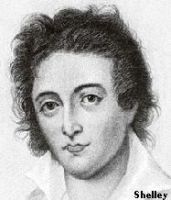
Percy Bysshe Shelley (August 4, 1792 – July 8, 1822)


Among the major English Romantic poets, Shelley is considered one of the finest lyric poets of the English language. He was married to the famous novelist Mary Shelley, author of Frankenstein.

On July 8, 1822, less than a month before his 30th birthday, Shelley drowned in a sudden storm off the coast of Italy. Shelley's body washed ashore and was cremated on the beach near Viareggio. He was later buried in Rome.


Some of my Shelley favorites:


Asia: From Prometheus Unbound

My soul is an enchanted boat,
Which, like a sleeping swan, doth float
Upon the silver waves of thy sweet singing;
And thine doth like an angel sit
Beside a helm conducting it,
Whilst all the winds with melody are ringing.
It seems to float ever, for ever,
Upon that many-winding river,
Between mountains, woods, abysses,
A paradise of wildernesses!
Till, like one in slumber bound,
Borne to the ocean, I float down, around,
Into a sea profound, of ever-spreading sound:

Meanwhile thy spirit lifts its pinions
In music's most serene dominions;
Catching the winds that fan that happy heaven.
And we sail on, away, afar,
Without a course, without a star,
But, by the instinct of sweet music driven;
Till through Elysian garden islets
By thee, most beautiful of pilots,
Where never mortal pinnace glided,
The boat of my desire is guided:
Realms where the air we breathe is love,
Which in the winds and on the waves doth move,
Harmonizing this earth with what we feel above.

We have past Age's icy caves,
And Manhood's dark and tossing waves,
And Youth's smooth ocean, smiling to betray:
Beyond the glassy gulfs we flee
Of shadow-peopled Infancy,
Through Death and Birth, to a diviner day;
A paradise of vaulted bowers,
Lit by downward-gazing flowers,
And watery paths that wind between
Wildernesses calm and green,
Peopled by shapes too bright to see,
And rest, having beheld; somewhat like thee;
Which walk upon the sea, and chant melodiously!


Love's Philosophy

The fountains mingle with the river
And the rivers with the ocean,
The winds of Heaven mix for ever
With a sweet emotion;
Nothing in the world is single,
All things by a law divine
In one spirit meet and mingle -
Why not I with thine?

See the mountains kiss high Heaven
And the waves clasp one another;
No sister-flower would be forgiven
If it disdained its brother;
And the sunlight clasps the earth,
And the moonbeams kiss the sea -
What are all these kissings worth
If thou kiss not me?


*note: I have always loved the mystery of the following

Ozymandias

I met a traveller from an antique land
Who said: "Two vast and trunkless legs of stone
Stand in the desert . . . Near them, on the sand,
Half sunk, a shattered visage lies, whose frown,
And wrinkled lip, and sneer of cold command,
Tell that its sculptor well those passions read
Which yet survive, stamped on these lifeless things,
The hand that mocked them, and the heart that fed:
And on the pedestal these words appear:
'My name is Ozymandias, king of kings:
Look on my works, ye Mighty, and despair!'
Nothing beside remains. Round the decay
Of that colossal wreck, boundless and bare
The lone and level sands stretch far away."


To Night

Swiftly walk over the western wave,
Spirit of Night!
Out of the misty eastern cave
Where, all the long and lone daylight,
Thou wovest dreams of joy and fear,
Which make thee terrible and dear, --
Swift be thy flight!

Wrap thy form in a mantle grey,
Star-inwrought!
Blind with thine hair the eyes of Day,
Kiss her until she be wearied out,
Then wander o'er city, and sea, and land,
Touching all with thine opiate wand --
Come, long-sought!

When I arose and saw the dawn,
I sighed for thee;
When light rode high, and the dew was gone,
And noon lay heavy on flower and tree,
And the weary Day turned to his rest,
Lingering like an unloved guest,
I sighed for thee.

Thy brother Death came, and cried
`Wouldst thou me?'
Thy sweet child Sleep, the filmy-eyed,
Murmured like a noontide bee
`Shall I nestle near thy side?
Wouldst thou me?' -- And I replied
`No, not thee!'

Death will come when thou art dead,
Soon, too soon --
Sleep will come when thou art fled;
Of neither would I ask the boon
I ask of thee, beloved Night --
Swift be thine approaching flight,
Come soon, soon!


--Percy Bysshe Shelley

Wednesday, August 02, 2006

Aug 3 - Rupert Brooke


Rupert Brooke (August 3, 1887 – April 23, 1915) was a British poet best known for his idealistic, naively patriotic War Sonnets written during the First World War.


He entered the army as an officer, as befitted his social class, and took part in the Antwerp expedition in October 1914. He sailed with the British Mediterranean Expeditionary Force on February 28, 1915 but developed septic pneumonia from an infected mosquito bite. He died at 4.20pm on April 23, 1915 off the island of Lemnos in the Aegean on his way to a battle at Gallipoli. As the expeditionary force had orders to depart immediately, he was buried at 11pm in an olive grove on the island of Skyros, Greece. His grave remains there today. -- Wikipedia

He was 27 when he died.


These poems were written before 1914:


The Little Dog's Day

All in the town were still asleep,
When the sun came up with a shout and a leap.
In the lonely streets unseen by man,
A little dog danced. And the day began.

All his life he'd been good, as far as he could,
And the poor little beast had done all that he should.
But this morning he swore, by Odin and Thor
And the Canine Valhalla—he'd stand it no more!

So his prayer he got granted—to do just what he wanted,
Prevented by none, for the space of one day.
"Jam incipiebo, sedere facebo,"
In dog-Latin he quoth, "Euge! sophos! hurray!"

He fought with the he-dogs, and winked at the she-dogs,
A thing that had never been heard of before.
"For the stigma of gluttony, I care not a button!" he
Cried, and ate all he could swallow—and more.

He took sinewy lumps from the shins of old frumps,
And mangled the errand-boys—when he could get 'em.
He shammed furious rabies, and bit all the babies,
And followed the cats up the trees, and then ate 'em!"

They thought 'twas the devil was holding a revel,
And sent for the parson to drive him away;
For the town never knew such a hullabaloo
As that little dog raised—till the end of that day.

When the blood-red sun had gone burning down,
And the lights were lit in the little town,
Outside, in the gloom of the twilight grey,
The little dog died when he'd had his day.


The Hill

Breathless, we flung us on the windy hill,
Laughed in the sun, and kissed the lovely grass.
You said "Through glory and ecstasy we pass;
Wind, sun, and earth remain, and birds sing still,
When we are old, are old...." "And when we die
All's over that is ours; and life burns on
Through other lovers, other lips" said I,
"Heart of my heart, our heaven is now, is won!"

"We are Earth's best, that learnt her lesson here.
Life is our cry. We have kept the faith!" we said;
"We shall go down with unreluctant tread
Rose-crowned into the darkness!".... Proud we were,
And laughed, that had such brave true things to say.
—And then you suddenly cried, and turned away.


Heaven

Fish (fly-replete, in depth of June,
Dawdling away their wat'ry noon)
Ponder deep wisdom, dark or clear,
Each secret fishy hope or fear.
Fish say, they have their Stream and Pond;
But is there anything Beyond?
This life cannot be All, they swear,
For how unpleasant, if it were!
One may not doubt that, somehow, Good
Shall come of Water and of Mud;
And, sure, the reverent eye must see
A Purpose in Liquidity.
We darkly know, by Faith we cry,
The future is not Wholly Dry.
Mud unto mud! -- Death eddies near --
Not here the appointed End, not here!
But somewhere, beyond Space and Time.
Is wetter water, slimier slime!
And there (they trust) there swimmeth One
Who swam ere rivers were begun,
Immense, of fishy form and mind,
Squamous, omnipotent, and kind;
And under that Almighty Fin,
The littlest fish may enter in.
Oh! never fly conceals a hook,
Fish say, in the Eternal Brook,
But more than mundane weeds are there,
And mud, celestially fair;
Fat caterpillars drift around,
And Paradisal grubs are found;
Unfading moths, immortal flies,
And the worm that never dies.
And in that Heaven of all their wish,
There shall be no more land, say fish.


--Rupert Brooke

Tuesday, May 30, 2006

May 31 - Walt Whitman


American poet Walt Whitman May 31, 1819 - March 26, 1892

Banned in Boston* and other cities because his books of poetry were considered obscene, offensive, pornographic by many straight-laced citizens of the era, he was a free spirit, original thinker, and revered by many--both while he lived and after he died.

*And of course sales went up, as they always do when this happens.

On April 14, 1865, Abraham Lincoln was assassinated. In honor of the beloved president, Whitman wrote the beautiful poem O Captain! My Captain!

I will admit the first time I heard this poem was in the movie Dead Poets Society. And I'll further admit that I wasn't familiar with the poet's name until on an episode of the television series Dr. Quinn, Medicine Woman the righteous townfolk wanted to burn his books.

I often wondered why I had never heard anything about or by this great poet. Hmm, I went to parochial schools. Maybe that explains it?


Some poems by Walt Whitman


O Captain! My Captain!

O Captain! my Captain! our fearful trip is done,
The ship has weathered every rack, the prize we sought is won,
The port is near, the bells I hear, the people all exulting,
While follow eyes the steady keel, the vessel grim and daring;
But O heart! heart! heart!
O the bleeding drops of red,
Where on the deck my Captain lies,
Fallen cold and dead.

O Captain! my Captain! rise up and hear the bells;
Rise up--for you the flag is flung--for you the bugle trills,
For you bouquets and ribboned wreaths--for you the shores a-crowding,
For you they call, the swaying mass, their eager faces turning;
Here Captain! dear father!
This arm beneath your head!
It is some dream that on the deck,
You've fallen cold and dead.

My Captain does not answer, his lips are pale and still;
My father does not feel my arm, he has no pulse nor will;
The ship is anchored safe and sound, its voyage closed and done;
From fearful trip the victor ship comes in with object won;
Exult O shores, and ring O bells!
But I, with mournful tread,
Walk the deck my Captain lies,
Fallen cold and dead.


O ME! O LIFE!

O ME! O life!…of the questions of these recurring;
Of the endless trains of the faithless—of cities fill'd with
the foolish;

Of myself forever reproaching myself, (for who more
foolish than I, and who more faithless?)

Of eyes that vainly crave the light—of the objects mean
—of the struggle ever renew'd;

Of the poor results of all—of the plodding and sordid
crowds I see around me;

Of the empty and useless years of the rest—with the
rest me intertwined;

The question, O me! so sad, recurring—What good
amid these, O me, O life?


Answer.
That you are here—that life exists, and identity;
That the powerful play goes on, and you will contribute
a verse.


TO THE READER AT PARTING.

Now, dearest comrade, lift me to your face,
We must separate awhile—Here! take from my lips
this kiss;

Whoever you are, I give it especially to you;
So long! —And I hope we shall meet again.

Saturday, April 22, 2006

April 23 - Shakespeare's Birthday

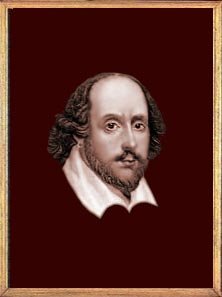
Happy Birthday William Shakespeare *April 23, 1564 - April 23, 1616


*The actual date of his birth is not known -- this is deemed close based on the April 26th date on his baptismal certificate.

Shakespeare's pithy (I love that word!) phrases are so pervasive we often don't realize that many common sayings, as well as book, movie, even song titles, were first found in his works until we happen to read him.

I'm by no means a Shakespeare scholar. I remember almost nothing about the first play I studied -- The Merchant of Venice, back in junior high school. For me, coming to appreciate him was an evolution of sorts. (I saw more movies of his plays than read them.)

So I have nothing new to offer about the Bard, only my own experiences with his works.

When I was in high school I memorized the first 8 lines of the Friends, Romans, countrymen speech from Julius Caesar and have over the years often tested my memory by repeating them to myself. I still know them all these years later.

Here is Mark Antony's clever speech made at Caesar's funeral:

Julius Caesar
Act 3, Scene 2,

Mark Antony:

Friends, Romans, countrymen, lend me your ears;
I come to bury Caesar, not to praise him;
The evil that men do lives after them,
The good is oft interréd with their bones,
So let it be with Caesar…. The noble Brutus
Hath told you Caesar was ambitious:
If it were so, it was a grievous fault,
And grievously hath Caesar answered it….
Here, under leave of Brutus and the rest,
(For Brutus is an honourable man;
So are they all; all honourable men)
Come I to speak in Caesar's funeral….
He was my friend, faithful and just to me:
But Brutus says he was ambitious;
And Brutus is an honourable man….
He hath brought many captives home to Rome,
Whose ransoms did the general coffers fill:
Did this in Caesar seem ambitious?
When that the poor have cried, Caesar hath wept:
Ambition should be made of sterner stuff:
Yet Brutus says he was ambitious;
And Brutus is an honourable man.
You all did see that on the Lupercal
I thrice presented him a kingly crown,
Which he did thrice refuse: was this ambition?
Yet Brutus says he was ambitious;
And, sure, he is an honourable man.
I speak not to disprove what Brutus spoke,
But here I am to speak what I do know.
You all did love him once, not without cause:
What cause withholds you then to mourn for him?
O judgement! thou art fled to brutish beasts,
And men have lost their reason…. Bear with me;
My heart is in the coffin there with Caesar,
And I must pause till it come back to me.


I will never forget an episode of Gilligan's Island where the castaways performed a musical version of Hamlet. It was, to borrow a famous advertising word, priceless. I can still "hear" them sing Neither a borrower nor a lender be to the Toreador Song from the opera Carmen. That speech follows:

Polonius, a pompous old windbag, offers advice to his son Laertes, leaving for Paris.

Hamlet
Act 1 scene 3

Lord Polonius:

Yet here, Laertes! aboard, aboard, for shame!
The wind sits in the shoulder of your sail,
And you are stay'd for. There; my blessing with thee!
And these few precepts in thy memory
See thou character. Give thy thoughts no tongue,
Nor any unproportioned thought his act.
Be thou familiar, but by no means vulgar.
Those friends thou hast, and their adoption tried,
Grapple them to thy soul with hoops of steel;
But do not dull thy palm with entertainment
Of each new-hatch'd, unfledged comrade. Beware
Of entrance to a quarrel, but being in,
Bear't that the opposed may beware of thee.
Give every man thy ear, but few thy voice;
Take each man's censure, but reserve thy judgment.
Costly thy habit as thy purse can buy,
But not express'd in fancy; rich, not gaudy;
For the apparel oft proclaims the man,
And they in France of the best rank and station
Are of a most select and generous chief in that.
Neither a borrower nor a lender be;
For loan oft loses both itself and friend,
And borrowing dulls the edge of husbandry.
This above all: to thine ownself be true,
And it must follow, as the night the day,
Thou canst not then be false to any man.
Farewell: my blessing season this in thee!


And a pair of favorite sonnets:

Sonnet 60: Like as the waves make towards the pebbled shore

Like as the waves make towards the pebbled shore,
So do our minutes hasten to their end;
Each changing place with that which goes before,
In sequent toil all forwards do contend.
Nativity once in the main of light,
Crawls to maturity, wherewith being crowned,
Crookèd eclipses 'gainst his glory fight,
And Time that gave doth now his gift confound.
Time doth transfix the flourish set on youth,
And delves the parallels in beauty's brow,
Feeds on the rarities of nature's truth,
And nothing stands but for his scythe to mow.
And yet to times in hope my verse shall stand,
Praising thy worth despite his cruel hand.


Sonnet 29: When in disgrace with Fortune and men's eyes

When, in disgrace with Fortune and men's eyes,
I all alone beweep my outcast state,
And trouble deaf heaven with my bootless cries,
And look upon myself and curse my fate,
Wishing me like to one more rich in hope,
Featured like him, like him with friends possessed,
Desiring this man's art and that man's scope,
With what I most enjoy contented least;
Yet in these thoughts myself almost despising,
Haply I think on thee, and then my state,
Like to the lark at break of day arising
From sullen earth, sings hymns at heaven's gate;
For thy sweet love remembered such wealth brings
That then I scorn to change my state with kings.

Thursday, April 06, 2006

April 7 - William Wordsworth

Happy Birthday -- William Wordsworth (1770-1850)

I have two poems by this great English poet. The first, written in 1804, a few years after the French Revolution (1789-99), when Emperor Napoleon was negating all the things the revolutionaries fought for resonates eerily now, 202 years later.


The World is too much with us

The world is too much with us; late and soon,
Getting and spending, we lay waste our powers:
Little we see in Nature that is ours;
We have given our hearts away, a sordid boon!
This Sea that bares her bosom to the moon;
The winds that will be howling at all hours,
And are up-gathered now like sleeping flowers;
For this, for everything, we are out of tune;
It moves us not.--Great God! I'd rather be
A Pagan suckled in a creed outworn;
So might I, standing on this pleasant lea,
Have glimpses that would make me less forlorn;
Have sight of Proteus rising from the sea;
Or hear old Triton blow his wreathèd horn.

--William Wordsworth 1804


This poem is, I think, familiar to every schoolchild who took literature class. It's exuberant and happy, reminding us of the simple beauties of nature.


I Wandered Lonely as a Cloud

I wandered lonely as a cloud
That floats on high o'er vales and hills,
When all at once I saw a crowd,
A host, of golden daffodils;
Beside the lake, beneath the trees,
Fluttering and dancing in the breeze.

Continuous as the stars that shine
And twinkle on the milky way,
They stretched in never-ending line
Along the margin of a bay:
Ten thousand saw I at a glance,
Tossing their heads in sprightly dance.

The waves beside them danced; but they
Out-did the sparkling waves in glee:
A poet could not but be gay,
In such a jocund company:
I gazed--and gazed--but little thought
What wealth the show to me had brought:

For oft, when on my couch I lie
In vacant or in pensive mood,
They flash upon that inward eye
Which is the bliss of solitude;
And then my heart with pleasure fills,
And dances with the daffodils.

--William Wordsworth 1804

Monday, February 27, 2006

Feb 27 - Longfellow

Henry Wadsworth Longfellow February 27, 1807 -- March 24, 1882

A great American poet. Here are some of my favorites--


The Sound of the Sea

The sea awoke at midnight from its sleep,
And round the pebbly beaches far and wide
I heard the first wave of the rising tide
Rush onward with uninterrupted sweep;
A voice out of the silence of the deep,
A sound mysteriously multiplied
As of a cataract from the mountain's side,
Or roar of winds upon a wooded steep.
So comes to us at times, from the unknown
And inaccessible solitudes of being,
The rushing of the sea-tides of the soul;
And inspirations, that we deem our own,
Are some divine of foreshadowing and foreseeing
Of things beyond our reason or control.


The Rainy Day

The day is cold, and dark, and dreary
It rains, and the wind is never weary;
The vine still clings to the mouldering wall,
But at every gust the dead leaves fall,
And the day is dark and dreary.

My life is cold, and dark, and dreary;
It rains, and the wind is never weary;
My thoughts still cling to the mouldering Past,
But the hopes of youth fall thick in the blast,
And the days are dark and dreary.

Be still, sad heart! and cease repining;
Behind the clouds is the sun still shining;
Thy fate is the common fate of all,
Into each life some rain must fall,
Some days must be dark and dreary.


Holidays

The holiest of all holidays are those
Kept by ourselves in silence and apart;
The secret anniversaries of the heart,
When the full river of feeling overflows;
--The happy days unclouded to their close;
The sudden joys that out of darkness start
As flames from ashes; swift desires that dart
Like swallows singing down each wind that blows!
White as the gleam of a receding sail,
White as a cloud that floats and fades in air,
White as the whitest lily on a stream,
These tender memories are;--a fairy tale
Of some enchanted land we know not where,
But lovely as a landscape in a dream.


-- Henry Wadsworth Longfellow

Wednesday, January 25, 2006

Jan. 25 - Robbie Burns Day

Note from Cat --

POESY is my new poetry blog.

I don't claim to be a poetry expert, don't analyze the masters, write poetry only to entertain myself and when the spirit moves me, and will showcase my favorites, those who inspire, move, connect, make a statement with which I agree.


And as today is Robbie Burns Day, Jan. 25, here's one of my favorite Burns poems.


To A Mouse, On Turning Her up in Her Nest With the Plough

Wee, sleekit, cow'rin', tim'rous beastie,
O what a panic's in thy breastie!
Thou need na start awa sae hasty,
Wi' bickering brattle!
I wad be laith to rin an' chase thee
Wi' murd'ring pattle!

I'm truly sorry man's dominion
Has broken nature's social union,
An' justifies that ill opinion
Which makes thee startle
At me, thy poor earth-born companion,
An' fellow-mortal!

I doubt na, whiles, but thou may thieve;
What then? poor beastie, thou maun live!
A daimen-icker in a thrave
'S a sma' request:
I'll get a blessin' wi' the lave,
And never miss't!

Thy wee bit housie, too, in ruin!
Its silly wa's the win's are strewin':
And naething, now, to big a new ane,
O' foggage green!
An' bleak December's winds ensuin'
Baith snell an' keen!

Thou saw the fields laid bare and waste
An' weary winter comin' fast,
An' cozie here, beneath the blast,
Thou thought to dwell,
Till, crash! the cruel coulter past
Out thro' thy cell.

That wee bit heap o'
leaves an' stibble
Has cost thee mony a weary nibble!
Now thou's turned out, for a' thy trouble,
But house or hald,
To thole the winter's sleety dribble
An' cranreuch cauld!

But, Mousie, thou art no thy lane
In proving foresight may be vain:
The best laid schemes o' mice an' men
Gang aft a-gley,
An' lea'e us nought but grief an' pain,
For promised joy.

Still thou art blest, compared wi' me!
The present only toucheth thee:
But, oh! I backward cast my e'e
On prospects drear!
An' forward, tho' I canna see,I guess an' fear!

-- Robert Burns 1785